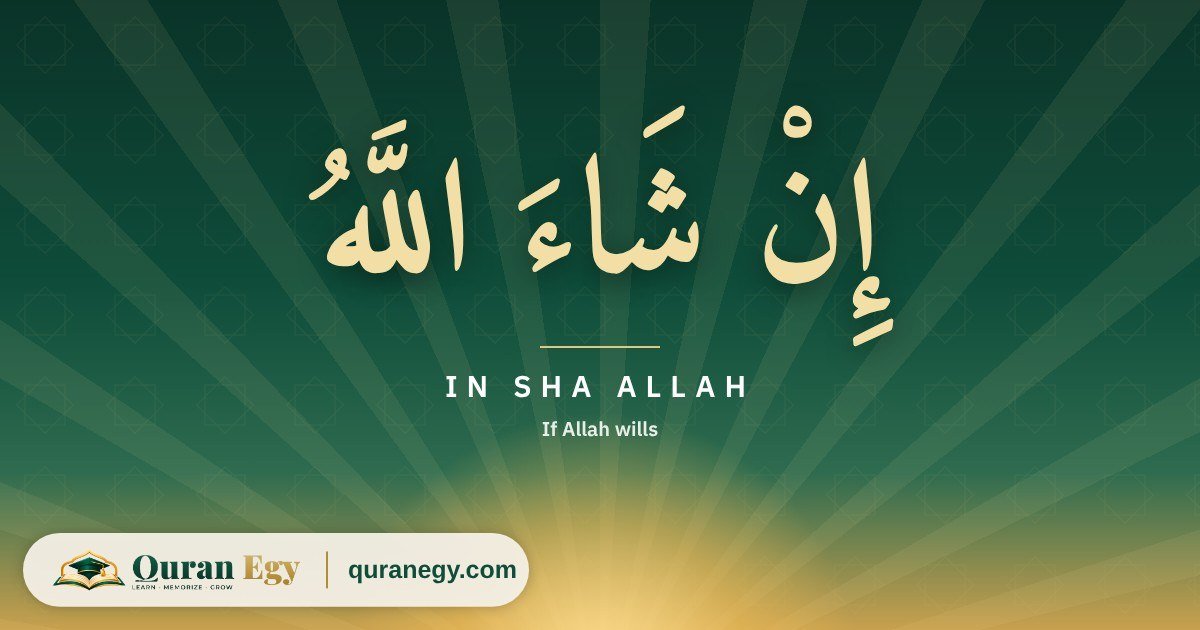
Insha Allah may be the most famous Arabic phrase in the world. Muslims say it many times a day: "See you tomorrow, insha Allah." "I'll finish the project next week, insha Allah." "We're travelling in the summer, insha Allah." Even people who are not Muslim often know it, sometimes from a Muslim friend or colleague who says it at the end of every plan.
But because it is so common, it is also misunderstood. Some people use it as a polite way to say "probably not". Others are not sure how to write it, or how it is different from Masha Allah. This guide explains what the phrase really means, where it comes from in the Quran, and how to use it the way the Prophet ﷺ and the Companions did.
What does Insha Allah mean?
Insha Allah (إن شاء الله) means "if Allah wills". It is said about something you plan or hope to do in the future.
The phrase is made of three words:
| Word | Arabic | Meaning |
|---|---|---|
| In | إنْ | if |
| Sha'a | شاءَ | He wills, He wants |
| Allah | الله | Allah |
So when you say "I will call you tonight, insha Allah", the full meaning is: "I will call you tonight, if Allah wills it." You are making a real plan, and at the same time admitting that the plan only happens if Allah allows it.
That is the heart of the phrase. It is not doubt about your own intention. It is honesty about who is really in control of tomorrow.
The verse that teaches us to say it
The command to say insha Allah comes in Surah Al-Kahf:
وَلَا تَقُولَنَّ لِشَيْءٍ إِنِّي فَاعِلٌ ذَٰلِكَ غَدًا إِلَّا أَن يَشَاءَ اللَّهُ ۚ وَاذْكُر رَّبَّكَ إِذَا نَسِيتَ
And never say of anything, "I will surely do that tomorrow," except [adding], "If Allah wills." And remember your Lord when you forget. (Al-Kahf 18:23-24)
The books of tafsir mention the story behind these verses. Some people of Quraysh, advised by scholars of the People of the Book, came to the Prophet ﷺ with three questions: about the young men of the cave, about the traveller who reached the east and the west, and about the soul. The Prophet ﷺ told them he would answer the next day, but he did not add insha Allah. The revelation then paused for a number of days, which was hard for him, until Surah Al-Kahf came down with the answers and with this lesson for every believer.
Two things stand out in these verses:
- The lesson was given to the best of creation. If the Prophet ﷺ was taught to say insha Allah, then every one of us needs it even more.
- There is a door for forgetting. "Remember your Lord when you forget." If you forget to say it, say it when you remember. Allah did not make the command harsh.
Insha Allah in the stories of the Prophets
The Quran shows several Prophets and righteous people using this phrase, often at moments of great trust.
Isma'il, peace be upon him, when his father told him about the dream of sacrifice, answered:
سَتَجِدُنِي إِن شَاءَ اللَّهُ مِنَ الصَّابِرِينَ
You will find me, if Allah wills, among the patient. (As-Saffat 37:102)
Musa, peace be upon him, when he asked Al-Khidr to teach him, promised:
سَتَجِدُنِي إِن شَاءَ اللَّهُ صَابِرًا
You will find me, if Allah wills, patient. (Al-Kahf 18:69)
Yusuf, peace be upon him, when he welcomed his family after years of separation, said:
ادْخُلُوا مِصْرَ إِن شَاءَ اللَّهُ آمِنِينَ
Enter Egypt, if Allah wills, in safety. (Yusuf 12:99)
The father-in-law of Musa, in Madyan, said to him: "You will find me, if Allah wills, among the righteous." (Al-Qasas 28:27)
In each of these, the speaker is confident and sincere, yet humble. Isma'il does not say "I am patient". He says he will be patient if Allah wills. That humility is exactly what made his patience real.
What the Prophet ﷺ taught about it
The story of Sulayman. The Prophet ﷺ told the story of Prophet Sulayman, peace be upon him, who said one night that he would visit his wives and each of them would give birth to a son who would fight in the path of Allah. An angel told him to say insha Allah, but he did not say it. In the end only one wife gave birth, and to an incomplete child. The Prophet ﷺ said: "If he had said insha Allah, he would not have failed, and it would have helped him reach what he wanted." (Sahih Al-Bukhari and Sahih Muslim)
The lesson is powerful. Saying insha Allah is not only good manners with Allah. It is also a reason for success, because it attaches your plan to the will of the One who makes things happen.
Even about death. When the Prophet ﷺ visited the graveyard, he would greet the people of the graves and say: "...and we will, insha Allah, join you." (Sahih Muslim) Death is the most certain thing in life, and still he said insha Allah. Scholars explain that this shows the phrase is about submitting to Allah's will, not only about uncertainty.
In oaths. The Prophet ﷺ said that whoever swears an oath and adds insha Allah has made an exception, so if he does not do it, he has not broken the oath. (Abu Dawud and Tirmidhi) This is one reason scholars give detailed rulings about oaths with insha Allah. The general lesson is simple: tie your promises to Allah's will.
When to say Insha Allah
The rule is easy to remember: say it about anything you intend to do in the future.
- "I'll be there at five, insha Allah."
- "We're planning to perform Umrah next year, insha Allah."
- "My son will start his Quran classes on Monday, insha Allah."
- "I'll pay you back at the end of the month, insha Allah."
It is not used for things that already happened, and it is not used for things you have no intention of doing. For past blessings, Muslims say Masha Allah or Alhamdulillah instead.
Insha Allah is not a polite "no"
This is the most common misuse of the phrase, and it has become a joke in many places. Someone asks "Will you come to the meeting?" and the other person says "Insha Allah", when in their heart they already know they will not come.
That is the opposite of what the phrase is for. Insha Allah is said with a real intention to do something. It expresses: "I fully plan to do this, and I ask Allah to allow it." Using it to hide a "no" turns a phrase of faith into a way of being unclear, and it can make people stop trusting it.
A few healthy habits:
- If you mean yes, say insha Allah and then follow through. Keep the promise.
- If you mean no, say no kindly. "I'm sorry, I can't make it this time" is honest and respectful.
- If you are not sure, say so. "I'll try, insha Allah, but I may be late" is clear and still humble.
When Muslims use it this way, insha Allah becomes a sign of reliability, not an escape.
How to write Insha Allah
In English you will see many spellings: Insha Allah, Inshallah, In sha Allah, Insha'Allah, Inshaallah. There is no single official spelling, because English letters cannot match Arabic exactly.
Many teachers recommend writing it as three words: In sha Allah or In sha' Allah, because that matches the three Arabic words in, sha'a and Allah. Insha Allah is also very common and widely understood.
In Arabic, the correct way is إن شاء الله, written as three separate words. A common mistake is to join the first two words as إنشاء الله. Insha' written that way is a different word that means "creating" or "establishing", so the joined form changes the meaning. When writing in Arabic, keep the words apart.
Insha Allah vs Masha Allah
These two phrases sound similar and are often mixed up, but they point in different directions in time.
| Insha Allah (إن شاء الله) | Masha Allah (ما شاء الله) | |
|---|---|---|
| Meaning | If Allah wills | What Allah has willed |
| Time | The future | The present or past |
| Used for | Plans, hopes, promises | Blessings you see, achievements, beauty |
| Example | "I'll visit you next week, insha Allah." | "Your son memorized Juz' Amma, masha Allah!" |
Masha Allah comes from Surah Al-Kahf too. A man is reminded to say, when he enters his garden: "What Allah willed. There is no power except with Allah" (Al-Kahf 18:39). It is a way of admiring a blessing while remembering its source.
So the simple rule is: future, insha Allah; present blessing, masha Allah.
Teaching Insha Allah to children
Children make plans all day long: what they will play, what they will eat, where they will go at the weekend. That makes insha Allah one of the easiest phrases to teach them.
- Use it with every plan you share. "Tomorrow we'll go to the park, insha Allah." Children copy the rhythm of their parents' speech.
- Keep your insha Allah promises. If a parent says "insha Allah" and never follows through, the child learns that the phrase means "no". Keeping the promise teaches what it really means.
- Tell the story behind the verse. Explain that even the Prophet ﷺ was taught to say it, and that the answer to the questions came after he learned the lesson.
- Teach the difference from Masha Allah with a game. Say a sentence and let them shout the right phrase: "I'll finish my homework later" (insha Allah), "Look at this beautiful drawing" (masha Allah).
- Connect it to tawakkul. Older children can learn that we plan and work hard, and then trust Allah with the result.
If you want your child to learn daily phrases and duas like these with their meanings, our Duas and Adhkar course covers them in short one-to-one classes. Our Quran classes for kids include Surah Al-Kahf's stories and short lessons on Islamic manners as children progress.
Pronunciation tips
- In is short, with a clear n: in.
- Sha'a has a long aa and ends with a light hamzah, a small catch in the throat: shaa-'a.
- Allah here has a heavy, full l, because it comes after the "a" sound of sha'a.
Said slowly, it sounds like in shaa-'al-laah. Our online Tajweed course helps with these sounds in its first level, and our Arabic language course is a good next step if you want to understand everyday phrases like this one. You might also like our guides to the meaning of Alhamdulillah, the meaning of Assalamualaikum and Inna lillahi wa inna ilayhi raji'un.
Azhari-trained teachers · male & female · kids and adults
Frequently asked questions
What does Insha Allah mean in English?
It means "if Allah wills". It is said about something you plan or hope to do in the future.
Where in the Quran are we told to say Insha Allah?
In Surah Al-Kahf, verses 23 and 24: "And never say of anything, 'I will surely do that tomorrow,' except [adding], 'If Allah wills.'"
Is it Inshallah or In sha Allah?
Both are common. In sha Allah is closer to the three Arabic words. In Arabic, write it as three separate words, إن شاء الله, not إنشاء الله.
What is the difference between Insha Allah and Masha Allah?
Insha Allah is for the future: "if Allah wills". Masha Allah is for a blessing you see now or that already happened: "what Allah has willed".
What if I forget to say Insha Allah?
Say it when you remember. The same verse says: "And remember your Lord when you forget."
Is it wrong to say Insha Allah when I don't plan to do something?
Yes, it goes against the purpose of the phrase. Insha Allah should come with a real intention. If you do not plan to do something, it is better to say so kindly.
Can non-Muslims say Insha Allah?
Many do, especially when living or working with Muslims, and it is usually taken as a friendly and respectful gesture.