Our online Arabic course is for anyone who wants to understand the Quran, follow a Friday khutbah, or simply speak with Arabic-speaking family and friends. You learn Arabic online with a native Egyptian teacher, live and one-on-one, from your first letters to reading real texts and holding a conversation.
A lot of people try apps first and stop after a few weeks. Apps are good for words, but they can't tell you why a sentence is built the way it is or correct how you say it. A teacher can. And because every class is one-on-one, it moves at your speed, not the speed of a group.
Who this course is for
- Adults who recite the Quran but don't understand it, and want to.
- Children growing up abroad who are losing their Arabic, or never learned it.
- New Muslims who want to understand prayers, duas and the Quran.
- Students and professionals who need Modern Standard Arabic for study or work.
No previous Arabic is needed for level 1.
Quranic Arabic or Modern Standard Arabic?
Both use the same alphabet and grammar, and much of the same vocabulary. The difference is focus:
- Quranic Arabic puts the Quran at the center. You learn the words that come up most often in the Quran, the grammar you need to understand verses, and you read short surahs with their meaning.
- Modern Standard Arabic focuses on reading, writing and speaking for daily life, news and study.
In the trial class, tell your teacher which one you want. Many students mix the two.
The six levels
Level 1: Reading and writing
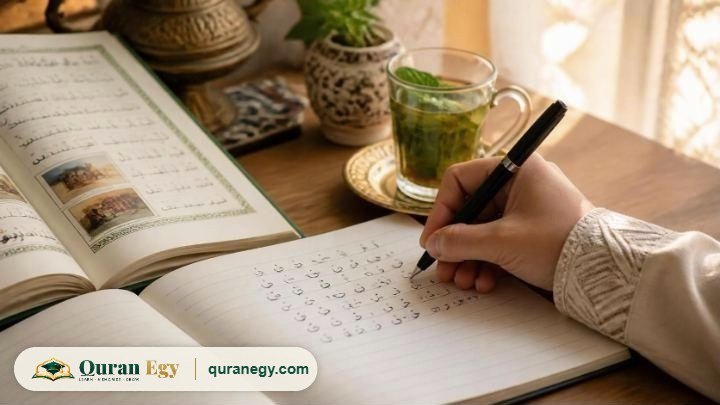
The alphabet, vowels and handwriting, so you can read and write simple words.
Level 2: Core vocabulary
The most common words in the Quran and in daily life, with short sentences.
Level 3: Basic grammar
Nouns, verbs and particles, gender and number, and the simple sentence.
Level 4: Verb patterns and roots
How Arabic builds words from three-letter roots. This is the point where many students say the Quran "opens up", because one root suddenly explains a dozen words.
Level 5: Reading texts
Short passages from the Quran, hadith and simple modern texts, with grammar analysis.
Level 6: Speaking and listening
Conversation practice, listening to recitations and talks, and expressing yourself with confidence.
Each level ends with a test and a certificate.
How classes work
Classes are live on Zoom or Google Meet, 30, 45 or 60 minutes. The teacher uses a shared screen, short exercises and plenty of speaking. Each week you get a little homework, usually 10 to 15 minutes a day of vocabulary and reading.
How long does it take to learn Arabic?
With three classes a week, students usually complete the six levels in around twelve months. You won't need to wait that long to feel progress, though. Most students can understand the general meaning of common surahs, such as Al-Fatiha and the short surahs of Juz' Amma, after the first few levels.
You can read our article on the meaning of Surah Al-Fatiha to get a feel for how much a little Arabic changes your prayer.
Price
Arabic classes are part of our monthly plans. Advanced Arabic (Nahw, Sarf and Balagha) is offered at $10 per hour. See the pricing page for details.
Certified Al-Azhar teachers · male & female · kids and adults
Frequently asked questions
Is Arabic hard to learn? It's different from English, not impossible. The alphabet takes a few weeks. Grammar takes longer, but it's very regular once you see the patterns.
Do you teach Egyptian dialect? Our main course teaches Quranic and Modern Standard Arabic. If you also want spoken Egyptian Arabic, mention it in the trial class.
Can my child learn Arabic and Quran together? Yes. Many children split their classes, for example two Quran classes and one Arabic class a week.
Will I be able to understand the Quran? You'll understand much of it in general, and you'll be able to use a dictionary and tafsir with confidence. Deep understanding takes years, but the first steps come quickly.