Alhamdulillah is probably the phrase Muslims say more than any other. We say it when someone asks how we are, after a meal, when we sneeze, when good news arrives and, if we are trying, when bad news arrives too. It is the opening line of Al-Fatiha, so every Muslim repeats it at least seventeen times a day in the obligatory prayers alone.
Because it is so familiar, it is easy to say it without thinking. This guide slows it down: what the words actually mean, how the Quran uses them, when the Prophet ﷺ said them, and why such a short phrase carries so much weight.
What does Alhamdulillah mean?
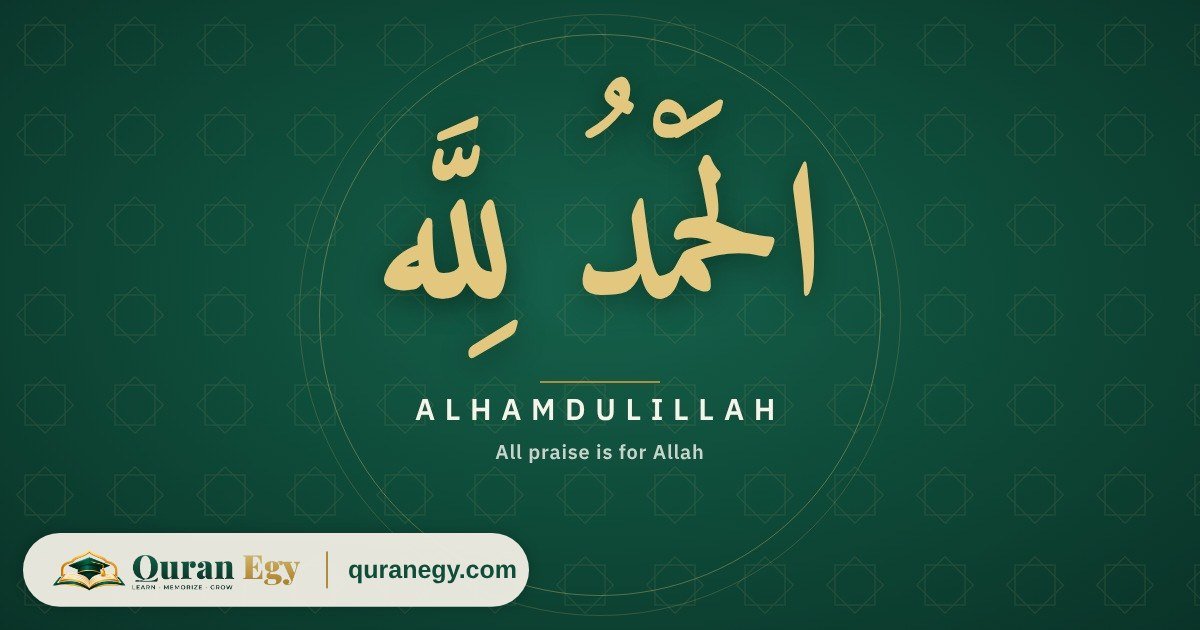
Alhamdulillah (الحمد لله) means "all praise is for Allah" or "all praise and thanks belong to Allah". In English you will also see it written as Al-hamdu lillah, Alhamdulilah or Al Hamdu Lillah. They are all the same phrase.
It is made of three parts:
| Part | Arabic | Meaning |
|---|---|---|
| Al | الـ | "the", here meaning all or every kind of |
| Hamd | حمد | praise that comes with love and gratitude |
| Lillah | لله | for Allah, belonging to Allah |
The small word al at the start does a lot of work. It turns "praise" into "all praise", every kind of praise, from every creature, at every time. The phrase is not just "I praise Allah". It is a statement that praise, in its full sense, belongs to Him alone.
Hamd and shukr: praise and thanks
Arabic has two close words, hamd (praise) and shukr (thanks), and scholars have long pointed out the difference.
- Shukr is thanks for a favour you received. You thank someone because they did something for you.
- Hamd is praise for who someone is, as well as what they have done. It includes thanks, but it goes further.
So when you say Alhamdulillah, you are not only thanking Allah for your food or your health. You are praising Him for being who He is: the Most Merciful, the Wise, the Creator, even in a moment when you feel you have received nothing special. That is why the phrase fits both easy days and hard ones.
Alhamdulillah in the Quran
The Quran opens with it. The first verse after the Basmalah in Surah Al-Fatiha is:
الْحَمْدُ لِلَّهِ رَبِّ الْعَالَمِينَ
All praise is for Allah, Lord of all the worlds. (Al-Fatiha 1:2)
You can read more about this verse and the rest of the surah in our guide to the meaning of Surah Al-Fatiha.
Four other surahs also begin with Alhamdulillah: Al-An'am, Al-Kahf, Saba' and Fatir. Each one praises Allah for a different kind of blessing. Al-An'am mentions the creation of the heavens and the earth, Al-Kahf the sending down of the Book, Saba' His ownership of everything, and Fatir the creation of the angels.
The phrase also closes things in the Quran. The prayer of the people of Paradise ends with it:
وَآخِرُ دَعْوَاهُمْ أَنِ الْحَمْدُ لِلَّهِ رَبِّ الْعَالَمِينَ
And the last of their call will be: All praise is for Allah, Lord of all the worlds. (Yunus 10:10)
So Alhamdulillah is both how the Quran begins and how the believers' story ends.
What the Prophet ﷺ said about Alhamdulillah
The Sunnah gives this phrase a weight that is easy to miss.
It fills the scale. The Prophet ﷺ said: "Purity is half of faith, and Alhamdulillah fills the scale." (Sahih Muslim)
It is the best dua. He ﷺ said: "The best remembrance is La ilaha illa Allah, and the best supplication is Alhamdulillah." (Tirmidhi, graded hasan)
Why would praise count as the best dua when it does not ask for anything? One explanation scholars give is that a person who praises Allah is showing that they trust Him completely, and praise is the most fitting way to approach the One you are about to ask.
Allah is pleased with it. The Prophet ﷺ said: "Allah is pleased with His servant who eats a meal and praises Him for it, and drinks a drink and praises Him for it." (Sahih Muslim)
That is a striking hadith. Something as ordinary as finishing a glass of water, followed by one sincere word, can earn the pleasure of Allah.
When to say Alhamdulillah
You can say Alhamdulillah at any time. But the Sunnah ties it to specific moments, and learning these is a simple way to build a habit.
When you wake up
الْحَمْدُ لِلَّهِ الَّذِي أَحْيَانَا بَعْدَ مَا أَمَاتَنَا وَإِلَيْهِ النُّشُورُ
Alhamdu lillahil-ladhi ahyana ba'da ma amatana wa ilayhin-nushur.
All praise is for Allah who gave us life after He had caused us to die, and to Him is the return. (Sahih Al-Bukhari)
Sleep is described as a small death. Waking up is a fresh gift, and the first words of the day recognise that.
After eating
الْحَمْدُ لِلَّهِ الَّذِي أَطْعَمَنِي هَذَا وَرَزَقَنِيهِ مِنْ غَيْرِ حَوْلٍ مِنِّي وَلَا قُوَّةٍ
Alhamdu lillahil-ladhi at'amani hadha wa razaqanihi min ghayri hawlin minni wa la quwwah.
All praise is for Allah who fed me this and provided it for me without any might or power from me. (Abu Dawud and Tirmidhi)
When you sneeze
The Prophet ﷺ taught that when one of us sneezes, we say Alhamdulillah. The person who hears it replies Yarhamuk Allah (may Allah have mercy on you), and the one who sneezed answers Yahdikumullahu wa yuslihu balakum (may Allah guide you and set your affairs right). (Sahih Al-Bukhari)
Children love this one, because it is a small conversation they can practise with their family every day.
After the prayer
After each obligatory prayer, it is Sunnah to say SubhanAllah 33 times, Alhamdulillah 33 times and Allahu Akbar 33 times, then complete the hundred with La ilaha illa Allahu wahdahu la sharika lah, lahul-mulku wa lahul-hamdu wa huwa 'ala kulli shay'in qadir. (Sahih Muslim)
When something good happens
When the Prophet ﷺ saw something that pleased him, he would say:
الْحَمْدُ لِلَّهِ الَّذِي بِنِعْمَتِهِ تَتِمُّ الصَّالِحَاتُ
Alhamdu lillahil-ladhi bi ni'matihi tatimmus-salihat.
All praise is for Allah, by whose favour good things are completed. (Ibn Majah)
When something difficult happens
And when he saw something he disliked, he would say:
الْحَمْدُ لِلَّهِ عَلَى كُلِّ حَالٍ
Alhamdulillahi 'ala kulli hal.
All praise is for Allah in every situation. (Ibn Majah)
This is one of the most powerful habits a Muslim can have. It does not mean pretending that a loss does not hurt. It means holding on to the belief that Allah is still wise and merciful, even when we cannot see the reason yet.
Alhamdulillah in hard times
Saying Alhamdulillah when things go well comes naturally. Saying it when they don't is where it becomes worship.
Think of someone who loses a job, falls ill or loses a loved one. If they say Alhamdulillah 'ala kulli hal, they are not denying the pain. They are making three quiet statements at once:
- Allah knows what I do not know.
- What I still have is a gift from Him.
- I trust that He will reward patience.
The Prophet ﷺ said that the affair of the believer is amazing, because everything is good for him: if something good happens he is grateful, and that is good for him, and if something bad happens he is patient, and that is good for him. (Sahih Muslim)
Alhamdulillah is the word that holds both of those responses together.
How to answer "How are you?" with Alhamdulillah
In many Muslim families, the automatic answer to "How are you?" is "Alhamdulillah". It is a beautiful habit, and it also says something honest: whatever my situation, I am in a state where praise is due to Allah.
You can make it more meaningful with small additions:
- Alhamdulillah, bikhayr: "Praise be to Allah, I'm well."
- Alhamdulillah 'ala kulli hal: for a harder day.
- Alhamdulillah, wa anta?: "Praise be to Allah, and you?"
Teaching Alhamdulillah to children
Children pick up Alhamdulillah quickly because it is short and they hear it constantly. The trick is to help them connect it to real moments rather than repeating it like a sound.
A few ideas that work well at home:
- Say it out loud yourself. After meals, when you find something you lost, when the rain starts. Kids copy what they see.
- Play "three Alhamdulillahs" at bedtime. Ask your child to name three things they are thankful for today and say Alhamdulillah after each one.
- Use the sneezing dua. It is a fun, interactive way to practise.
- Explain one word at a time. Tell a young child that hamd means saying good things about Allah, and lillah means "for Allah". Small explanations stick.
If your child is learning daily duas and adhkar, our Duas and Adhkar course teaches the Alhamdulillah duas above with their meanings, in short one-to-one classes. And our Quran classes for kids start with Al-Fatiha, so the very first verse a child memorizes begins with this phrase.
Common spelling and pronunciation questions
People often search for the right way to write Alhamdulillah in English. There is no single official spelling, because English letters cannot match every Arabic sound. Alhamdulillah is the most common form, and Al-hamdu lillah is closer to the Arabic grammar.
For pronunciation, two sounds need care:
- The ح in hamd is a deep, breathy "h" from the middle of the throat, not the soft English "h".
- The ل in lillah is light and thin, because it comes after the "i" sound of li. (In Allah at the start of a sentence, or after an "a" or "u" sound, the same letter is heavy and full.)
A teacher can fix these in a few minutes, and our online Tajweed course covers the letters of the throat in its first level.
Certified Al-Azhar teachers · male & female · kids and adults
Frequently asked questions
What is the meaning of Alhamdulillah in English?
It means "all praise is for Allah" or "all praise and thanks belong to Allah". The word al turns it into all praise, not just some.
Is Alhamdulillah the same as saying thank you to Allah?
It includes thanks, but it is wider. Thanks (shukr) is for a favour. Praise (hamd) is for who Allah is, as well as for what He gives.
What is the reward for saying Alhamdulillah?
The Prophet ﷺ said that it fills the scale of good deeds, and he called it the best supplication. Allah is also pleased with the servant who praises Him after eating and drinking.
When should I say Alhamdulillah?
Any time. The Sunnah mentions waking up, after eating, after sneezing, after the prayer, when something good happens, and when something difficult happens, using Alhamdulillahi 'ala kulli hal.
How many times should I say Alhamdulillah after prayer?
33 times, together with 33 SubhanAllah and 33 Allahu Akbar, completed to 100 with La ilaha illa Allah wahdahu la sharika lah.
Can non-Arabic speakers say Alhamdulillah?
Yes. It is said by Muslims in every language, and learning its meaning makes it far more powerful when you say it.