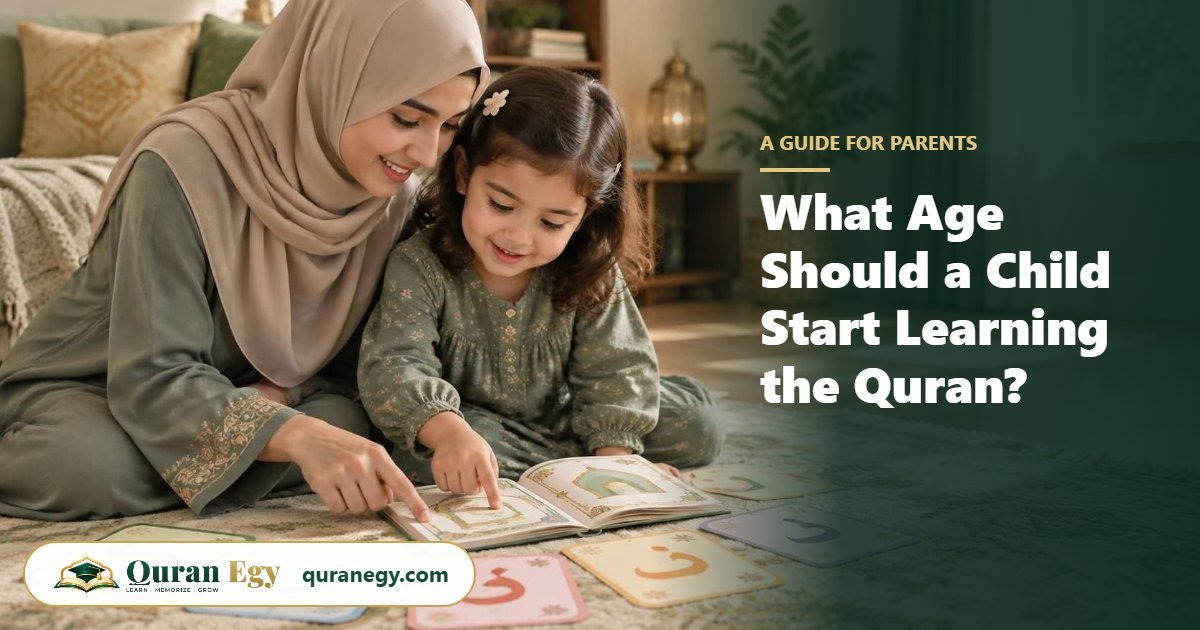
Most children are ready to start learning to read the Quran between 4 and 5 years old, beginning with the Arabic letters through the Noorani Qaida. Listening and memorizing short surahs by ear can start even earlier, from around 3. There is no age that is too late: children who start at 9 or 12 often move faster, because they focus longer.
So the better question is not "what age" but "what kind of learning fits my child's age". This guide breaks it down by age group, with signs of readiness and a simple plan for each stage.
Key takeaways
- Age 3: listening and short surahs by ear. No formal reading yet.
- Age 4 to 6: the best time to start the Noorani Qaida, in short 20 to 30 minute lessons.
- Age 7 to 10: reading the Mushaf, first Tajweed rules, and structured Hifz of Juz Amma.
- Age 11 and up: faster progress, longer classes, and serious Hifz or Tajweed goals.
- Readiness matters more than age: can your child sit for 15 minutes and repeat sounds after you?
Why there is no single "right" age
Children differ a lot. One 4-year-old can sit, focus and copy sounds for twenty minutes. Another is still happiest running around. Islam does not set a starting age for learning the Quran, but it does place great value on it. The Prophet ﷺ said: "The best of you are those who learn the Quran and teach it" (Sahih al-Bukhari 5027).
What we can say is that early, gentle exposure helps, and that forced, long lessons at a young age often backfire.
Learning the Quran by age group
| Age | What they can do | Lesson length | Main goal |
|---|---|---|---|
| 3 | Listen, repeat short phrases | 5 to 10 minutes at home | Love of the Quran, short surahs by ear |
| 4 to 6 | Learn letters and vowels | 20 to 30 minutes | Noorani Qaida, first surahs |
| 7 to 10 | Read words and lines | 30 to 45 minutes | Reading the Mushaf, basic Tajweed, Juz Amma |
| 11 to 14 | Read fluently, memorize steadily | 45 to 60 minutes | Tajweed, Hifz plan, meanings |
Age 3: listening and loving
At three, the aim is not reading. It is warmth. Play a short surah in the car, recite Al-Fatiha together at bedtime, and praise every attempt. Many three-year-olds can recite Al-Ikhlas and Al-Fatiha by ear simply because they hear them every day. Our guide to Surah Al-Fatiha's meaning gives you simple words to explain it.
Age 4 to 6: the best time to start reading
This is when most children begin formal lessons. The Noorani Qaida teaches the letters, their sounds, the short vowels and then joining, step by step. Lessons should be short, around 20 to 30 minutes, with lots of repetition and praise. Our Noorani Qaida course starts from age 4 and usually takes about 3 to 6 months.
Age 7 to 10: reading the Mushaf
By now most children can read words and short lines. This is a good age to move from the Qaida to the Mushaf, learn the first Tajweed rules, and start a structured Hifz of Juz Amma. Our Tajweed rules for kids shows the first rules with easy examples.
Age 11 to 14: faster and deeper
Older children focus longer and understand why rules matter. A child who starts at 11 often catches up quickly with one who started at 5. This is also a good age to start learning meanings and some Quranic Arabic.
Signs your child is ready for lessons
- Can sit and pay attention for about 15 minutes.
- Can repeat a sound or word after you.
- Recognises some shapes or letters (in any language).
- Is curious when they hear the Quran.
- Is happy to talk to a new adult on a screen, or will be with you sitting nearby.
If your child shows three or more of these, a short trial class is a good next step.
When should a child start Hifz?
Light memorization by ear can start at 3 or 4 with the shortest surahs. A structured Hifz plan, with daily new lines and revision, usually works best once a child reads the Mushaf, around 7 to 10. Starting full Hifz before a child can read well often means they memorize with mistakes that are hard to fix later.
For a free way to follow your child's progress in Juz Amma, use our Quran memorization tracker for kids. Our list of the best surahs to memorize first gives you a simple order.
Common mistakes parents make
- Lessons that are too long. Thirty minutes of focus is better than an hour of struggle.
- Comparing with other children. Each child has their own speed.
- Starting Hifz before reading. Reading first makes memorization stronger.
- Skipping Tajweed early on. Wrong sounds learned at 6 are hard to fix at 12.
- Only the teacher practises. Five minutes of daily reading at home doubles the effect of class.
How online classes fit young children
Online one-to-one classes work well for children because the teacher can focus on one child, use pictures and games on screen, and keep lessons short. Our Quran classes for kids are for ages 4 to 14, with 20 to 30 minute classes for younger children and 45 minutes for older ones, plus monthly reports for parents. For more on how classes run, read our guide to online Quran classes for kids.
A free trial class will tell you. Ages 4 to 14.
Frequently asked questions
What is the best age to start learning the Quran?
Most children start reading lessons between 4 and 5 with the Noorani Qaida. Listening and memorizing short surahs by ear can start from about 3.
Can a 3-year-old learn the Quran?
Yes, by listening and repeating. Short surahs such as Al-Fatiha and Al-Ikhlas are often learned by ear at this age. Formal reading usually waits until 4 or 5.
Is it too late to start at 10 or 12?
No. Older children often progress faster because they focus longer and understand the rules. Many catch up within a year.
How long should Quran lessons be for a 5-year-old?
About 20 to 30 minutes, with short breaks for praise and repetition.
When should my child start Hifz?
Short surahs by ear can start early. A full Hifz plan works best once the child reads the Mushaf well, usually around 7 to 10.
Are online Quran classes good for young children?
Yes, if they are one-to-one and short. The teacher can keep a young child's attention with pictures, games and praise.