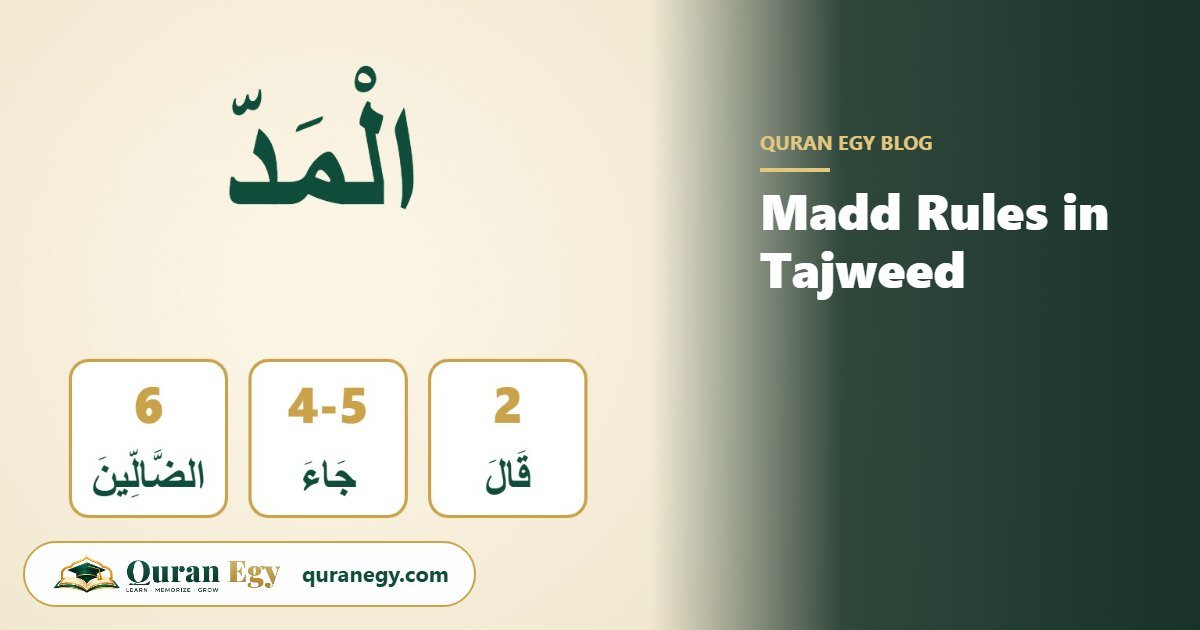
Madd means stretching a vowel sound. In Tajweed it happens on three letters, ا و ي, when they are long vowels. Every madd is measured in counts (harakat), roughly the time it takes to fold or open a finger at a steady pace. The basic madd is 2 counts. It becomes longer, 4, 5 or 6 counts, when a hamza or a sukun comes after the madd letter. If you learn what comes after the madd letter, you know the rule.
Key takeaways
- Madd letters: ا after fathah, و after dammah, ي after kasrah.
- Natural madd (tabi'i): 2 counts, nothing after it.
- Hamza after it: connected madd 4 or 5 counts, separated madd 4 or 5 counts in the common Hafs reading.
- Sukun after it: necessary madd 6 counts; madd when stopping 2, 4 or 6.
- One rule per sitting: keep the same length for the same type throughout your recitation.
The three madd letters
| Letter | Condition | Example |
|---|---|---|
| ا (alif) | after a fathah | قَالَ |
| و (waw) | sakin after a dammah | يَقُولُ |
| ي (ya) | sakin after a kasrah | قِيلَ |
There is also madd leen: a sakin و or ي after a fathah, like خَوْف and بَيْت. It is only stretched when you stop on the word.
Madd chart: types and counts
The counts below follow the Hafs reading as it is printed and taught in most Mushafs today.
| Type | What comes after the madd letter | Counts | Example |
|---|---|---|---|
| Natural (tabi'i) | nothing special | 2 | قَالَ، يَقُولُ |
| Connected (muttasil) | hamza in the same word | 4 or 5 (6 if you stop on the hamza) | جَاءَ، السَّمَاءِ |
| Separated (munfasil) | hamza at the start of the next word | 4 or 5 | يَا أَيُّهَا، إِنَّا أَعْطَيْنَاكَ |
| Necessary (lazim) | a fixed sukun or shaddah | 6 | الضَّالِّينَ، الْحَاقَّةُ |
| Madd when stopping ('arid lil-sukun) | sukun only because you stop | 2, 4 or 6 | الْعَالَمِينْ، الرَّحِيمْ |
| Leen when stopping | sukun because you stop, after و/ي leen | 2, 4 or 6 | خَوْفْ، الْبَيْتْ |
| Substitute (badal) | hamza comes before the madd letter | 2 | آمَنُوا، إِيمَانًا |
| Exchange ('iwad) | stopping on tanween with fathah | 2 | عَلِيمًا ← عَلِيمَا |
The main types explained
Natural madd: 2 counts
This is the foundation. If nothing comes after the madd letter, stretch it 2 counts, no more. Most beginner mistakes are here: reading قَالَ as a quick "qal" or dragging it to 4.
Madd with a hamza after it
- Connected (wajib muttasil): the hamza is in the same word, as in جَاءَ. It must be lengthened, 4 or 5 counts.
- Separated (ja'iz munfasil): the madd letter ends one word and the hamza starts the next, as in فِي أَنْفُسِكُمْ. In the common Hafs reading it is 4 or 5 counts.
Choose one length, for example 4, and keep it the same every time in the same recitation.
Madd with a sukun after it
- Necessary madd (lazim): 6 counts. The sukun is fixed and does not change whether you stop or continue, as in الضَّالِّينَ in Surah Al-Fatiha. It also appears in some opening letters of surahs, like the ل and م in الم.
- Madd when stopping ('arid lil-sukun): 2, 4 or 6. The sukun appears only because you stop, as at the end of most verses of Al-Fatiha: الْعَالَمِينْ، الرَّحِيمْ، الدِّينْ.
Madd in the opening letters
Some surahs open with single letters. Letters whose names have three sounds with a madd in the middle, like ل (لَامْ), م (مِيمْ), ن (نُونْ), ص (صَادْ) and ق (قَافْ), are stretched 6 counts. Letters with two sounds, like ر (رَا) and ه (هَا), get 2 counts.
Practise on Surah Al-Fatiha
| Word | Type | Counts |
|---|---|---|
| الرَّحْمَٰنِ | natural | 2 |
| الْعَالَمِينْ (when stopping) | 'arid lil-sukun | 2, 4 or 6 |
| مَالِكِ | natural | 2 |
| نَسْتَعِينْ (when stopping) | 'arid lil-sukun | 2, 4 or 6 |
| الضَّالِّينَ | necessary | 6 |
Pick one length for the verse endings, say 4, and keep it the same for all seven verses. Our Surah Al-Fatiha meaning guide explains each verse.
Common mistakes
| Mistake | Correction |
|---|---|
| Changing the length from verse to verse | Keep one length for the same type in one sitting |
| Stretching letters that are not madd | Only ا و ي as long vowels, or leen when stopping |
| Cutting الضَّالِّينَ short | Necessary madd is always 6 counts |
| Stretching the ي in بَيْت while continuing | Leen is only stretched when you stop |
Where madd fits in your Tajweed path
Madd usually comes after makharij al-huruf, the noon and meem rules and qalqalah. The Tajweed rules for beginners guide lists the full order. A teacher is the quickest way to get the counts even, because most students cannot hear their own uneven lengths. Our online Tajweed course covers madd in its first levels with live correction.
One-to-one · Azhari-trained teachers · male & female
Frequently asked questions
What is madd in Tajweed?
Madd is stretching the long vowels ا و ي for a set number of counts.
How many counts is natural madd?
Two counts.
What is the difference between connected and separated madd?
In connected madd the hamza is in the same word; in separated madd it starts the next word. Both are 4 or 5 counts in the common Hafs reading.
Which madd is always 6 counts?
The necessary madd (madd lazim), as in الضَّالِّينَ.
How long is the madd at the end of a verse when I stop?
2, 4 or 6 counts. Choose one and keep it the same.
What is a count in madd?
A steady unit of time, about the time to fold or open one finger at an even pace.