You have taken your shahadah, alhamdulillah. Now the questions start. How do I pray when I cannot read Arabic? Which surahs do I need first? Where do I even begin with the Quran? Many new Muslims feel embarrassed to ask these things at the masjid, especially when everyone around them seems to have known it all since childhood.
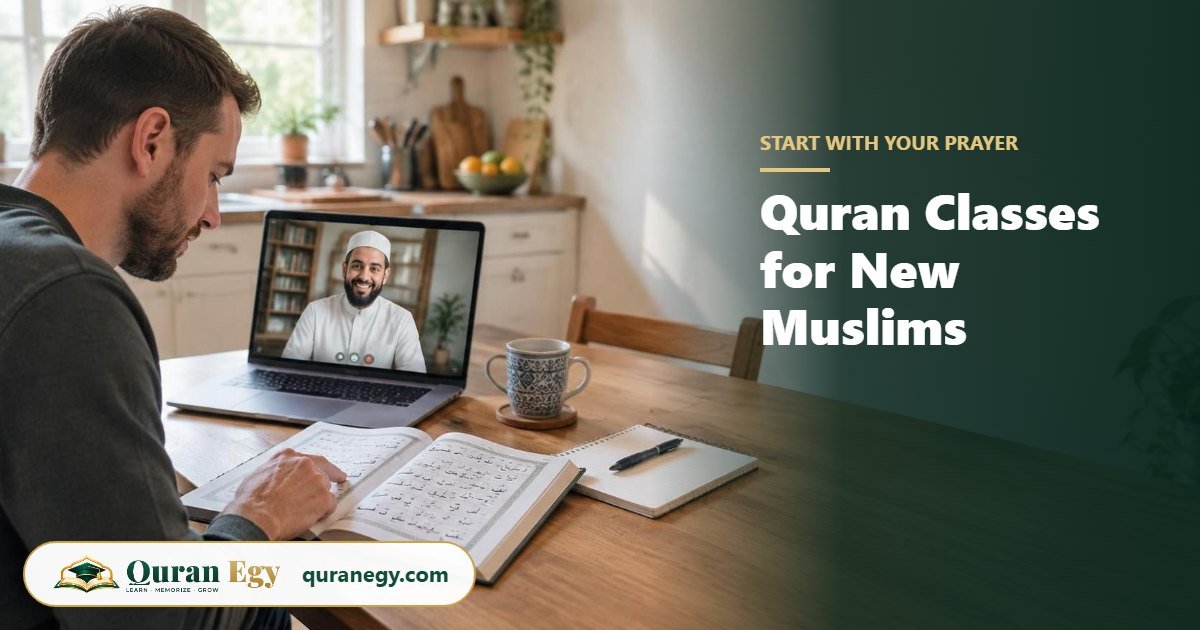
Our Quran classes for new Muslims are built for exactly this stage. You learn one-to-one with a patient teacher, starting with what you need for your prayer this week, and moving at your own pace from there. No question is too basic.
Key takeaways
- First goal: pray correctly. You start with Surah Al-Fatiha and the words of salah, with meaning, often within the first two to four weeks.
- Then reading. The Arabic letters through the Noorani Qaida, so you can read the mushaf yourself.
- Alongside: the basics of Islam. Wudu, the pillars, halal and haram, at your pace, through Islamic Studies.
- One-to-one, online, with a male or female teacher. Camera optional.
- From $40 a month. The first class is free.
What new Muslims need first
Every revert is different, but in our experience the order below works for most people. It puts the things you use every day first.
| Stage | What you learn | Typical time* |
|---|---|---|
| 1. Prayer essentials | Al-Fatiha with meaning, Allahu Akbar, the words of ruku', sujud and tashahhud | 2 to 4 weeks |
| 2. Short surahs | Al-Ikhlas, Al-Falaq, An-Nas, Al-Kawthar and Al-'Asr, to recite after Al-Fatiha | 3 to 6 weeks |
| 3. Arabic letters | The alphabet, vowels and joining through the Noorani Qaida | 2 to 4 months |
| 4. Reading the mushaf | Reading short and then longer pages with basic Tajweed | ongoing |
| 5. Understanding | Meanings of what you recite, through Arabic or tafsir | ongoing |
*With 3 classes a week and 10 to 15 minutes of daily practice. Every student is different, so your teacher will give you your own plan.
Stages 1 and 2 use transliteration and listening, so you can pray properly long before you can read Arabic. Stage 3 starts at the same time, in a small part of each class.
What a first class looks like
- A short, friendly conversation. Your teacher asks how long you have been Muslim, what you already know, and what you want to reach first.
- Al-Fatiha, line by line. You hear each line, repeat it, and learn what it means. Our article on the meaning of Surah Al-Fatiha is a good companion.
- Your questions. Many new Muslims use this time to ask about wudu, prayer times or what to do if they make a mistake in salah.
- A plan. You leave knowing what to practise before the next class.
The first class is free, so you can see if the teacher and the pace suit you before paying anything.
Learning the basics of Islam alongside the Quran
Reading the Quran is one part of a new Muslim's learning. Most of our revert students also want clear, calm answers about daily practice. In our Islamic Studies course your teacher covers:
- Wudu, ghusl and the conditions of prayer
- The five pillars and the six pillars of faith
- Halal and haram in food and daily life
- The life of the Prophet ﷺ, in simple stories
- Common questions from family and friends who are not Muslim
Islamic Studies can be booked as part of your monthly plan or at $10 per hour if you want a few focused sessions. Daily phrases such as Insha Allah, Alhamdulillah and Assalamu alaikum are covered too, and our short guides on Alhamdulillah and Assalamualaikum are a good place to start.
Why a one-to-one teacher helps reverts
No embarrassment. In a group, many reverts stay quiet so they do not slow others down. One-to-one, the class moves exactly at your speed.
Sounds that English does not have. Letters like 'ayn, ḥa and qaf are hard to learn from videos. A teacher hears your mistakes and fixes them early, before they become habits.
Kindness and patience. Our teachers are used to adult beginners. They know that you may have a full-time job, a family that is not Muslim, and a lot of new information at once.
A male or a female teacher. Sisters can study with a female Quran teacher online, with the camera on or off.
Prices
| Plan | Classes | Price |
|---|---|---|
| Starter | 2 days a week | $40 / month |
| Standard | 3 days a week | $55 / month |
| Plus | 4 days a week | $70 / month |
| Intensive | 5 days a week | $85 / month |
| Islamic Studies only | as many hours as you book | $10 / hour |
Class length is 30, 45 or 60 minutes, set with you. No contracts: pay month by month and pause or cancel any time. See the pricing page for payment methods.
Tips for your first months as a new Muslim
- Pray with what you know. You do not have to wait until you can read Arabic. Learn Al-Fatiha first and pray with it.
- Little and often. Ten minutes every day beats an hour once a week.
- Listen daily. Play Al-Fatiha and the short surahs from a clear reciter while driving or cooking.
- Ask, do not guess. Write your questions down during the week and bring them to class.
- Be gentle with yourself. Allah says: "Allah does not burden a soul beyond that it can bear" (Al-Baqarah 2:286).
Patient one-to-one teachers · male & female · camera optional
Frequently asked questions
I just took my shahadah. What should I learn first?
Surah Al-Fatiha and the words of salah, so you can pray. Then the short surahs, then the Arabic letters through the Noorani Qaida.
Can I pray before I can read Arabic?
Yes. You can learn Al-Fatiha by listening and repeating, with transliteration, and pray with it while you learn to read.
How long does it take a new Muslim to read the Quran?
Most adults learn the letters and start reading simple pages within 2 to 4 months with 3 classes a week and a little daily practice.
Do you have Quran classes for reverts with a female teacher?
Yes. Sisters can choose a female teacher, and the camera is optional.
How much do the classes cost?
From $40 a month for 2 classes a week. Islamic Studies alone is $10 per hour. The first class is free.
Do I need to know any Arabic to start?
No. Many of our revert students start with no Arabic at all.