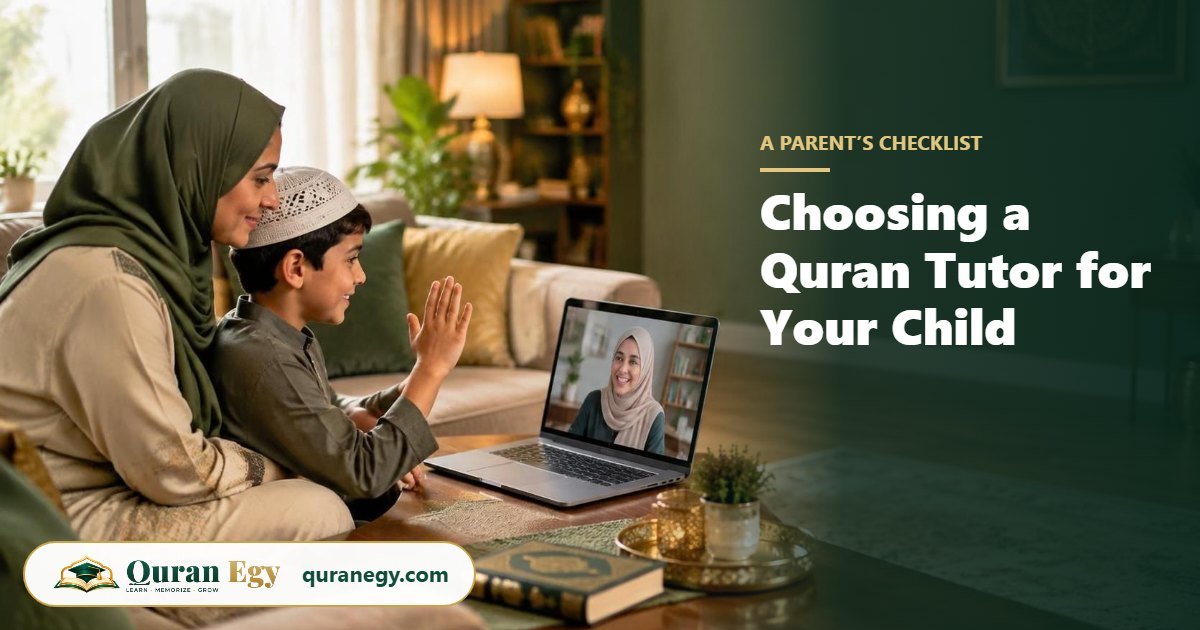
The right Quran tutor for a child is someone who recites correctly, explains simply, and keeps a young learner engaged for the whole class. A teacher can be a beautiful reciter and still be the wrong fit for a seven-year-old. In practice, most parents can tell within the free trial and the first four weeks whether a tutor is right.
This checklist covers what to look for before you book, what to watch in the trial class, and how to judge progress after the first month. It works whether you choose us or another academy.
Key takeaways
- Check three things first: correct recitation, experience with children of your child's age, and a clear plan.
- Use the free trial as an interview. Watch how the tutor corrects mistakes and how your child reacts.
- Match the length to the age: about 30 minutes for under-eights, 45 minutes for older children.
- Expect a plan and reports, not just "we will see".
- Give it four weeks, then judge by what your child can now read or recite.
The 10-point checklist
| # | What to check | What good looks like |
|---|---|---|
| 1 | Recitation | Clear letters, correct Tajweed, calm pace |
| 2 | Qualification | Hafiz or hafiza, ideally with an Ijazah |
| 3 | Experience with children | Has taught your child's age group for years |
| 4 | Teaching style | Short steps, praise, patience with repetition |
| 5 | Language | Can explain in English (or your home language) |
| 6 | A clear plan | Knows what your child will reach in 3 months |
| 7 | Class length | 30 min for young children, 45 min for older ones |
| 8 | Progress reports | Regular, written, specific |
| 9 | Flexibility | Fair rescheduling, works with school times |
| 10 | Safety and comfort | Parent can watch; female teacher available if you prefer |
1. Correct recitation
Everything else depends on this. Ask the tutor to recite a short surah in the trial. Listen for clear, distinct letters, especially the throat letters and qaf, and for steady stretching of the long vowels. A child copies the teacher exactly, mistakes included.
2. Qualification
A tutor who is a hafiz or hafiza with an Ijazah has been tested by a qualified teacher. For reading and early Tajweed, a well-trained teacher without an Ijazah can be excellent. For Hifz and higher Tajweed, the Ijazah matters more.
3. Experience with children
Teaching a five-year-old the letter ba is a different skill from correcting an adult's recitation. Ask directly: "How many children my child's age have you taught, and what do you do when they lose focus?"
4. Teaching style
Good tutors for children break things into tiny steps, repeat without sighing, praise effort, and change activity before the child gets bored. If the tutor talks for long stretches while your child sits silently, that is a warning sign.
5. Language
Your child needs to understand the instructions. For children who grew up in the USA, UK or Australia, a tutor who explains in clear English makes a big difference, especially in the first months.
6. A clear plan
After the trial, a good tutor should be able to say something like: "She knows most letters. In the next 8 to 10 weeks we will finish the Noorani Qaida joining rules and start reading short surahs." Our Noorani Qaida guide shows what those stages look like.
7. Class length
Most children under eight lose focus after 25 to 30 minutes. Longer is not better at this age. Three short classes a week usually beat one long one.
8. Progress reports
You should get a written update on what was covered, what needs practice, and what comes next. At Quran Egy every plan includes a monthly report, and the 5-day plan a weekly one.
9. Flexibility
Children get sick, schools change timetables. Ask how rescheduling works and whether missed classes are lost.
10. Safety and comfort
You should be able to sit in on any class. Many parents prefer a female teacher for young children or for daughters, and a good academy will offer one without fuss.
Questions to ask in the free trial
- "What level do you think my child is at, and why?"
- "What will they be able to do in three months?"
- "How many classes a week do you recommend, and how long?"
- "What should we practise at home between classes?"
- "How will I know if it is working?"
Clear, specific answers are a good sign. Vague answers ("it depends, we will see") are not.
Red flags
- The tutor rarely corrects mistakes, or corrects them harshly.
- Your child is mostly silent while the tutor talks.
- Classes start late or the camera and sound are often poor.
- No plan after the first two or three classes.
- Pressure to pay for several months in advance.
How to tell if it is working after four weeks
| If your child started at... | After about 4 weeks, you might see... |
|---|---|
| No Arabic letters | Recognises most single letters and their sounds |
| Knows letters | Reads short joined words with vowels |
| Reads slowly | Reads a few lines with fewer stops, starts basic Tajweed |
| Memorizing short surahs | One or two new short surahs, recited correctly from memory |
Every child is different, so treat this as a rough guide. What matters most is steady progress and a child who is happy to come back to class. For memorization, our free Hifz Tracker for kids helps you see progress week by week.
How we match tutors at Quran Egy
When you book a free trial for your child, we ask about age, level, schedule and whether you prefer a male or female teacher. We then match your child with a teacher who has experience with that age group. In our Quran classes for kids, younger children usually start with the Noorani Qaida course, then move on to reading and short-surah memorization. You can meet our team on the teachers page.
If the first teacher is not the right fit, tell us and we will change the teacher. That is normal, and it is better than staying with a poor match.
Our online Quran classes for kids guide also explains how a typical lesson runs and what children learn first.
Experienced with children · male & female teachers · 30-minute classes
Frequently asked questions
What should I look for in an online Quran tutor for my child?
Correct recitation, experience teaching your child's age group, a patient style, clear English, and a written plan for the next few months.
What age can a child start online Quran classes?
Many children start at 4 or 5 with short, playful classes on the Arabic letters.
How long should a Quran class be for a child?
About 30 minutes for children under eight, and 45 minutes for most older children.
Should my daughter have a female Quran teacher?
It is a family choice. Many parents prefer it for daughters and young children, and we offer female teachers on request.
How do I know if the tutor is good?
After about four weeks, your child should be reading or reciting something they could not before, and should be happy to attend.
Can we change the tutor if it is not working?
Yes. Tell us, and we will match your child with another teacher.