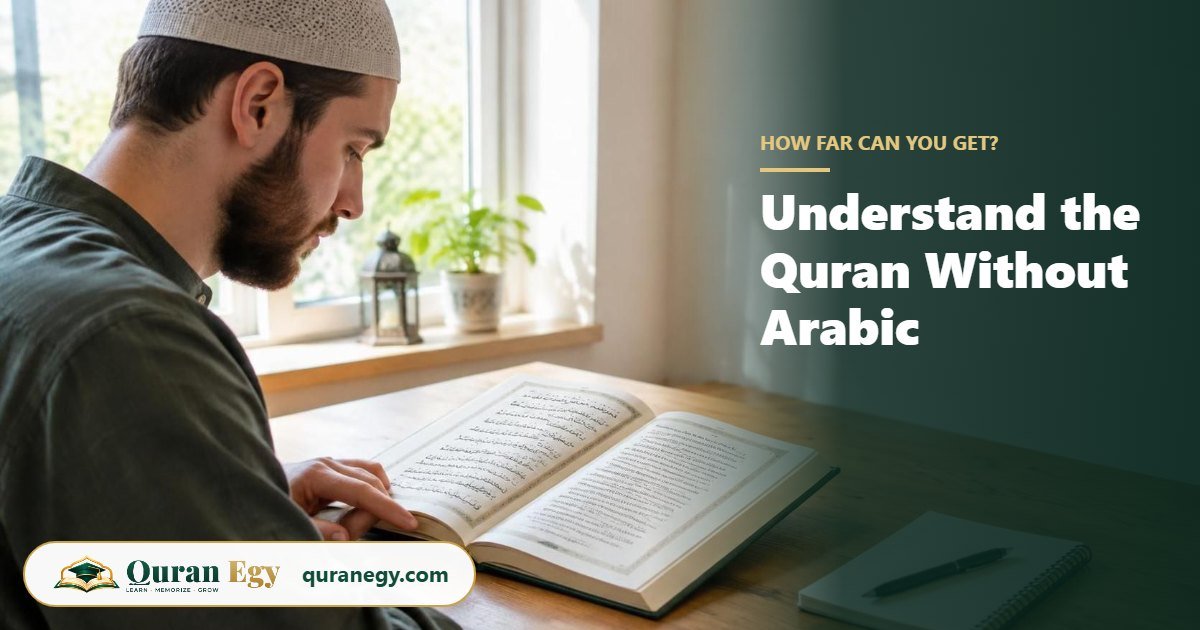
Yes, you can understand the message of the Quran without knowing Arabic, through a good translation and a simple tafsir. But to understand the words you recite in your own prayer, you need some Arabic, and less than most people think. A few months of focused study on the most common Quranic words and a handful of grammar patterns lets most learners follow Al-Fatiha, the short surahs and the daily adhkar as they recite.
This guide explains what a translation can and cannot give you, three realistic levels of understanding, and how to reach the first one in a few months.
Key takeaways
- Translation alone gives you the general meaning, but not the word-by-word connection while you pray.
- The Quran repeats a lot of vocabulary. A relatively small set of common words covers a large share of its text.
- Level 1 (a few months): follow Al-Fatiha, the short surahs and the words of salah.
- Level 2 (about a year): follow much of the general meaning of what you hear, with help from a dictionary.
- Level 3 (years): read classical tafsir in Arabic. This is for students of knowledge.
What a translation gives you, and what it misses
Allah says: "Do they not reflect upon the Quran?" (An-Nisa 4:82). A good English translation is a real help in that reflection. It gives you the stories, the commands, the promises and the warnings.
But a translation is an interpretation. Here is what gets lost:
| What you lose in translation | Example |
|---|---|
| Word roots that link ideas | رَحْمَٰن, رَحِيم and رَحِم (womb) all share one root |
| Exact shades of meaning | خَشْيَة and خَوْف are both "fear", but not the same fear |
| Word order and emphasis | إِيَّاكَ نَعْبُدُ puts "You alone" first for emphasis |
| Sound and rhythm | Rhymes and pauses that carry meaning in Arabic |
| Live connection in salah | Understanding each word as you say it, not afterwards |
The last point matters most to many Muslims. You can read a translation before prayer, but in salah you recite Arabic. Knowing what each word means as you say it changes the prayer.
Three levels of understanding
| Level | What you can do | How long it usually takes* |
|---|---|---|
| 1. Prayer level | Understand Al-Fatiha, the short surahs and the words of salah, word by word | 2 to 4 months |
| 2. Listener level | Follow the general meaning of many verses you hear, with a dictionary for the rest | about 12 months |
| 3. Scholar level | Read tafsir and classical texts in Arabic | several years |
*With 2 to 3 lessons a week and some daily review. Every learner is different.
Most people do not need Level 3. Level 1 alone transforms how prayer feels, and Level 2 is within reach of anyone who studies steadily for a year.
Why the Quran is easier to understand than you think
The vocabulary repeats. Words like اللَّه, رَبّ, قَالَ, آمَنُوا, الْأَرْض and السَّمَاوَات appear again and again. Learning the most frequent words first gives you a high return on your time.
Words are built from roots. Most Arabic words grow from three-letter roots. Learn the root k-t-b (ك ت ب, writing) and you can guess كِتَاب (book), كَاتِب (writer) and مَكْتُوب (written).
A few grammar patterns do a lot of work. Recognising "they did", "you did", "do!" and "those who believe" in their Arabic shapes unlocks hundreds of verses.
A 4-month starter plan
| Month | Focus | Practice |
|---|---|---|
| 1 | Al-Fatiha word by word, plus the words of ruku', sujud and tashahhud | Say the meaning in your head as you pray |
| 2 | Al-Ikhlas, Al-Falaq, An-Nas, Al-Kawthar, Al-'Asr | Learn 5 new words a day from these surahs |
| 3 | Common roots and the most frequent Quranic words | Spot the roots in the surahs you know |
| 4 | Basic verb and pronoun patterns | Read one short surah a week with a word-by-word guide |
Our article on the meaning of Surah Al-Fatiha is a good first step, and you can explore word-by-word meanings for any verse on Quran.com.
If you cannot read Arabic letters yet, start there. Understanding comes much faster once you can read the words yourself. See our guide to the Noorani Qaida.
Learning with a teacher
You can make good progress alone with a word-by-word mushaf. A teacher helps you go faster and avoid the common traps, such as false word guesses and mixing up similar roots.
Our Arabic language course has a Quranic Arabic track that puts the Quran at the centre: you learn the most frequent Quranic words, the grammar you need to understand verses, and you read short surahs with their meaning. Many students take two Quran classes and one Arabic class a week. If you want deeper grammar later (Nahw, Sarf and Balagha), Advanced Arabic is $10 per hour.
Regular plans start at $40 a month, and the first class is free. See pricing. If your goal is to understand the meaning of the verses in depth, our Islamic Studies course also includes tafsir.
Start by booking a free trial in the Arabic language course and tell your teacher that your goal is to understand the Quran.
Quranic Arabic one-to-one · beginners welcome · first class free
Frequently asked questions
Can I understand the Quran without knowing Arabic?
Yes, its message, through a good translation and tafsir. To understand the words while you recite, especially in prayer, you need some Arabic.
How much Arabic do I need to understand the Quran?
For your prayer and the short surahs, a few months of focused study. To follow most of what you hear, about a year of steady study.
Is Quranic Arabic different from Modern Standard Arabic?
They share the same alphabet and grammar and much of the vocabulary. Quranic Arabic focuses on the words and structures that appear in the Quran.
Should I learn to read Arabic before learning its meaning?
It helps a lot. Once you can read the letters, learning vocabulary and roots is much faster.
Is it enough to read the Quran in English?
Reading a translation is valuable and rewarding. But the Quran itself is the Arabic text, and recitation in prayer is in Arabic, so learning some Arabic brings you closer to it.
What is the fastest way to start?
Learn Al-Fatiha word by word this week, and think about each word's meaning in your next prayer.