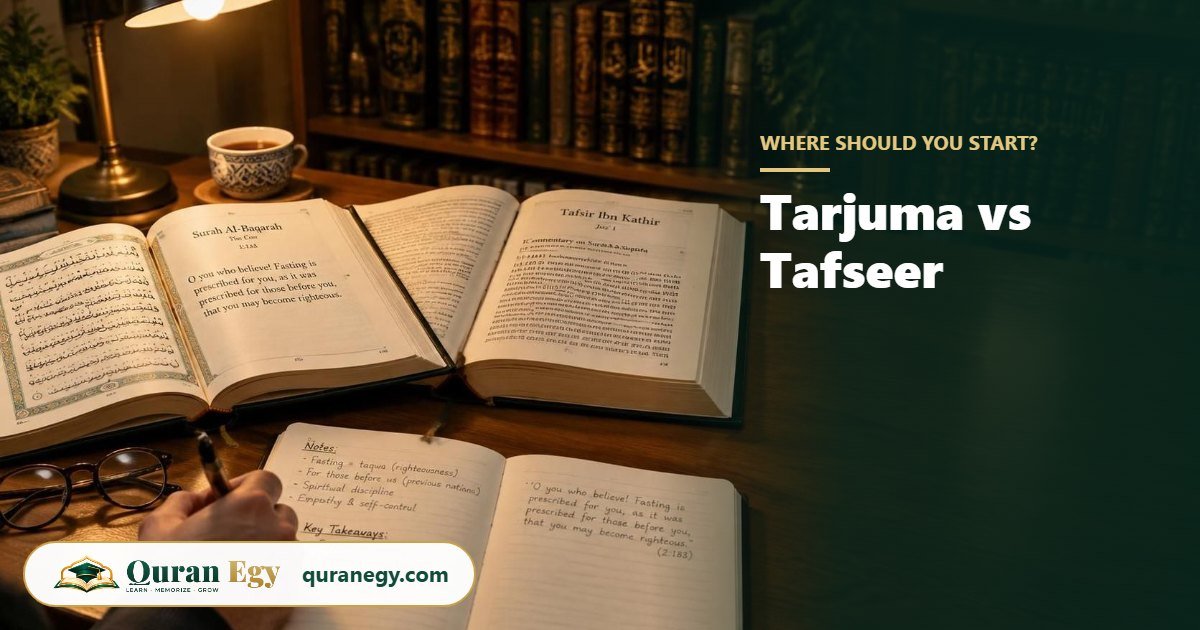
Tarjuma (تَرْجَمَة) is a translation of the meanings of the Quran into another language, usually one line or one verse at a time. Tafseer (تَفْسِير) is an explanation of the verses: their context, the meaning of key words, related hadith, and the lessons scholars took from them. A translation tells you what a verse says. A tafseer helps you understand why and how it applies. Most learners start with a translation and add a short tafseer once they want to go deeper.
Key takeaways
- Tarjuma = translation of meaning. Short, verse by verse, good for daily reading.
- Tafseer = explanation. Context, word meanings, hadith and lessons; much longer.
- No translation is the Quran itself. It is a human understanding of the meaning in another language.
- Start with a clear translation, then add a short tafseer for the surahs you recite most.
- Learning some Quranic Arabic connects both and lets you understand while you recite.
The difference at a glance
| Tarjuma (translation) | Tafseer (explanation) | |
|---|---|---|
| What it does | Gives the meaning in another language | Explains the meaning, context and lessons |
| Length | About the length of the Quran itself | Many volumes for the full Quran |
| Includes context? | Rarely, sometimes short footnotes | Yes: reasons of revelation, history |
| Includes hadith? | No | Often |
| Best for | Daily reading, first understanding | Study, reflection, answering questions |
| Time needed | Minutes a day | Longer study sessions |
An example from Al-Fatiha
Take the fourth verse of Al-Fatiha: مَالِكِ يَوْمِ الدِّينِ (1:4).
A translation gives you one line, for example: "Sovereign of the Day of Recompense" or "Master of the Day of Judgment." Two translators already chose different English words.
A tafseer explains much more: that الدِّين here means recompense and judgment, that Allah is the owner of every day but this Day is named because no one else will have any authority on it, that some reciters read the word as مَلِكِ (King) instead of مَالِكِ (Owner), and how this verse builds hope and fear together after the mercy mentioned in the verse before it.
You can see the full meaning of the surah in our guide to Surah Al-Fatiha's meaning.
Why no translation is "the Quran"
Muslims believe the Quran is the word of Allah in Arabic. A translation is a human attempt to carry its meaning into another language, and some meaning is always lost. Arabic words often hold several shades of meaning that one English word cannot hold. That is why many printed translations are titled "The Meaning of the Quran" or "Translation of the Meanings". It is also why prayer is performed in Arabic.
Popular English translations
Some widely used translations include:
- Sahih International: clear modern English, close to the Arabic.
- M.A.S. Abdel Haleem (Oxford): smooth, readable English.
- Abdullah Yusuf Ali: older style English, with many notes.
- Marmaduke Pickthall: older, literal style.
You can compare several translations verse by verse on quran.com.
Well-known works of tafseer
- Tafsir al-Tabari: one of the earliest major works, collecting reports from the first generations.
- Tafsir Ibn Kathir: explains verses using other verses and hadith; abridged English editions exist.
- Tafsir al-Qurtubi: rich on legal rulings.
- Tafsir al-Sa'di: shorter and simple, good for beginners; available in English.
For a beginner, a short tafseer such as al-Sa'di or an abridged Ibn Kathir is easier than starting with a multi-volume work.
Where should you start?
- Read a translation daily, even one page alongside your Arabic recitation.
- Pick one short surah a week you recite in prayer and read its tafseer.
- Learn common Quranic words. A few hundred words cover a large share of the text. Our guide to Quranic Arabic grammar for beginners shows the patterns.
- Study with a teacher when questions come up, so you understand verses within their proper context.
If you are not an Arabic speaker, our article on understanding the Quran without Arabic explains how far a translation can take you.
Learning tafseer and Arabic with Quran Egy
Our Islamic Studies classes include tafseer of the Quran with qualified teachers, booked by the hour at $10 an hour. Our online Arabic course teaches the vocabulary and grammar you need to understand the Quran directly, in six levels. Both are one-to-one, and your first class is free.
Tafseer and Quranic Arabic classes · one-to-one · first class free
Frequently asked questions
What is the difference between tarjuma and tafseer?
Tarjuma is a translation of the Quran's meaning into another language. Tafseer is a detailed explanation of the verses, including context, word meanings and lessons.
Is reading a translation enough?
It is a good start for understanding the general meaning. For deeper understanding of context and rulings, add a tafseer or study with a teacher.
Which tafseer is best for beginners in English?
Short works such as Tafsir al-Sa'di or an abridged Tafsir Ibn Kathir are easier starting points than multi-volume works.
Which English translation should I read?
Sahih International and Abdel Haleem are two widely used, readable options. Comparing two translations helps you see the range of meaning.
Is a translation of the Quran still the Quran?
No. The Quran is the Arabic text. A translation is a human rendering of its meaning, which is why prayer is in Arabic.
Do I need Arabic to study tafseer?
No. Many tafseer works are available in English. Learning some Quranic Arabic makes your study richer and lets you understand while you recite.