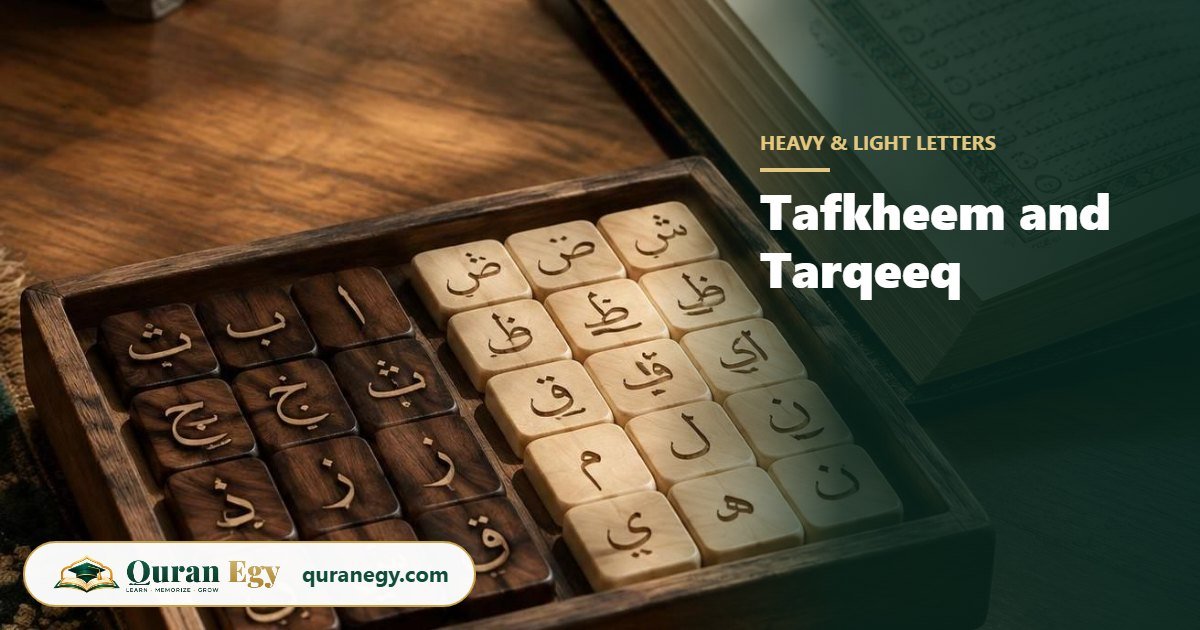
In Arabic, some letters are pronounced heavy and full and others light and thin. Tafkheem (التفخيم) means making a letter heavy: the back of the tongue rises towards the roof of the mouth, so the sound fills the mouth. Tarqeeq (الترقيق) means making it light: the tongue stays low. Mixing them up can change the meaning of a word, so this is one of the first things a Tajweed teacher corrects.
Key takeaways
- 7 letters are always heavy: خ ص ض غ ط ق ظ, collected in خُصَّ ضَغْطٍ قِظْ.
- Most letters are always light, like ت س ك د.
- 3 cases change: the letter ر, the ل in the name Allah, and the ا (alif), which follows the letter before it.
- Heaviness has levels: strongest with fatha, then damma, then kasra.
- ط vs ت: same place of articulation, but ط is heavy and ت is light.
The 7 always-heavy letters
These are the letters of isti'la (elevation). The back of the tongue always rises when you pronounce them:
خ ص ض غ ط ق ظ, remembered in the phrase خُصَّ ضَغْطٍ قِظْ.
Among them, four are the heaviest because the tongue also presses flat against the roof of the mouth (itbaq): ص ض ط ظ.
Levels of heaviness
A heavy letter is not equally heavy everywhere. A simple way that many teachers use:
| Level | Example |
|---|---|
| With fatha followed by alif (strongest) | طَا in طَائِفَةٌ |
| With fatha | ص in صَبْرًا |
| With damma | ق in قُلْ |
| With kasra (lightest, but still heavy) | ق in قِيلَ |
A heavy letter with sukoon follows the vowel before it, as in يَقْطَعُونَ.
Letters that change
- The letter ر: usually heavy with fatha or damma (رَبِّ, رُزِقُوا) and light with kasra (رِجَالٌ). With sukoon it depends on the letter before it.
- The ل in the name Allah: heavy after fatha or damma (قَالَ اللَّهُ, رُسُلُ اللَّهِ) and light after kasra (بِسْمِ اللَّهِ).
- Alif (ا): has no weight of its own. It is heavy after a heavy letter (قَالَ) and light after a light letter (كَانَ).
The difference between ط and ت
Both come from the same place: the tip of the tongue touching the gum behind the upper front teeth. The difference is the quality:
| ط | ت | |
|---|---|---|
| Weight | Heavy (tafkheem) | Light (tarqeeq) |
| Tongue | Back raised, middle pressed to the roof | Stays low |
| Example | طَابَ | تَابَ |
The same pairs exist for ص / س, ض / د and ظ / ذ. Our guide to makharij al-huruf explains where each letter comes from.
Common mistakes
- Making light letters heavy, especially س and ت next to a heavy letter.
- Rounding the lips on heavy letters. Heaviness comes from the tongue, not the lips.
- Making alif heavy after a light letter, as in كَانَ.
- Reading ق like a k or ط like a t, which is common for English speakers.
Learning tafkheem and tarqeeq with a teacher
These differences are easy to understand but hard to hear in yourself. A teacher compares pairs like سَارَ and صَارَ with you until your ear and tongue know the difference. It is covered in the online Tajweed course, Tajweed classes for adults and advanced Tajweed rules.
One-to-one Tajweed · male & female teachers · free trial
Frequently asked questions
What does tafkheem mean in Tajweed?
Making a letter heavy by raising the back of the tongue so the sound fills the mouth.
What are the heavy letters in Arabic?
خ ص ض غ ط ق ظ, collected in the phrase خُصَّ ضَغْطٍ قِظْ.
What is the difference between ط and ت?
They come from the same place, but ط is heavy, with the tongue raised and pressed, and ت is light.
Which letters can be heavy or light?
The letter ر, the ل in the name Allah, and the alif, which follows the letter before it.
What is the difference between Tajweed and tarteel?
Tajweed is the set of rules for pronouncing each letter correctly. Tarteel is reciting slowly and beautifully while applying those rules.