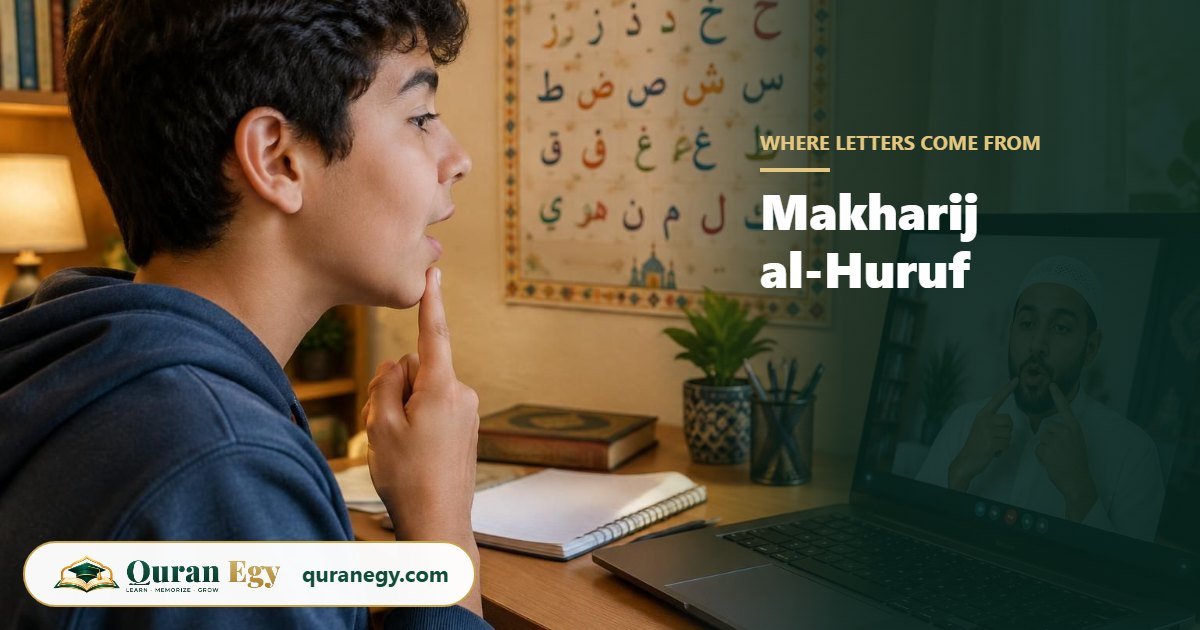
Makharij al-huruf are the places in the mouth and throat where each Arabic letter is produced. Scholars of Tajweed group them into 5 main areas (the empty space of the mouth, the throat, the tongue, the lips and the nose) and 17 exact points, following Imam Ibn al-Jazari. Learning them is the first step of Tajweed, because a letter from the wrong place can change the meaning of a word: qalb (heart) and kalb (dog) differ only in where the first letter is made.
This guide explains each area with a simple chart, and lists the letters that English speakers mix up most.
Key takeaways
- Makhraj (plural makharij) = the exit point of a letter.
- 5 areas: jawf (open mouth), halq (throat), lisan (tongue), shafatan (lips), khayshum (nose).
- 17 points in total; the tongue alone has 10.
- Test a letter's makhraj by putting a sukun on it after a hamzah: ab, at, aq.
- Hardest letters for English speakers: ع ح غ خ ق ض ص ط ظ.
How to find a letter's makhraj
Say the letter with a sukun after a hamzah with fathah: أَبْ, أَتْ, أَقْ. Where the sound stops is its makhraj. Try أَقْ and أَكْ: you will feel the qaf further back in the mouth than the kaf.
The 5 main areas
| Area | Arabic | Points | Letters |
|---|---|---|---|
| Open space of the mouth and throat | الجوف | 1 | the long vowels: ا و ي (madd letters) |
| Throat | الحلق | 3 | ء هـ · ع ح · غ خ |
| Tongue | اللسان | 10 | ق ك ج ش ي ض ل ن ر ط د ت ص س ز ظ ذ ث |
| Lips | الشفتان | 2 | ف · ب م و |
| Nose | الخيشوم | 1 | the ghunnah (nasal sound) of ن and م |
The throat letters
The throat has three levels, from deep to near the mouth:
| Level | Letters | Tip |
|---|---|---|
| Deepest part | ء هـ | The hamzah is a clean stop; the ha is a soft breath |
| Middle | ع ح | Tighten the middle of the throat; ح is a strong breathy "h", never English h |
| Top, near the mouth | غ خ | Like gargling: غ voiced, خ voiceless |
These six letters are where most non-Arabs struggle. If you say al-hamd with an English "h", the ح is lost. Our guide to the meaning of Alhamdulillah has a pronunciation tip for exactly this letter.
The tongue letters
The tongue has 10 points. In short:
| Part of the tongue | Letters | Note |
|---|---|---|
| Back, against the soft palate | ق | Deepest of the tongue letters, heavy |
| Back, slightly forward | ك | Lighter, with a puff of air |
| Middle, against the palate | ج ش ي | ي here is the consonant y, not the long vowel |
| Side edge of the tongue | ض | The hardest letter in Arabic; one or both sides against the upper molars |
| Front edge | ل | Light, except in Allah after a or u |
| Tip, slightly below the ل point | ن | With ghunnah when doubled |
| Tip and top, near ن | ر | One tap, never rolled many times |
| Tip against the roots of the upper front teeth | ط د ت | ط is heavy, د and ت are light |
| Tip near the lower front teeth | ص س ز | Whistling letters; ص is heavy |
| Tip touching the edge of the upper front teeth | ظ ذ ث | Tongue slightly out; ظ is heavy |
The lip letters and the nose
- ف: inside of the lower lip touching the tips of the upper front teeth.
- ب م و: both lips. ب and م close the lips fully; و rounds them without closing.
- The nose (khayshum) is the source of ghunnah, the nasal sound held for two counts in noon and meem with shaddah. Pinch your nose while saying inna: if the sound stops, the ghunnah is in the right place.
Letters English speakers mix up
| Mix-up | Example | How to fix it |
|---|---|---|
| ح said like هـ | الرَّحِيم read with a soft English h | Tighten the middle of the throat |
| ع dropped or said like ء | الْعَالَمِين read as alamin | Squeeze the middle of the throat, voice on |
| ق said like ك | قُلْ read as kul | Move it to the very back of the tongue |
| ص said like س | الصِّرَاط read thin, like sirat with s | Raise the back of the tongue, heavy sound |
| ض said like د | الضَّالِّين read as if it began with د | Use the side of the tongue |
| ث and ذ said like س and ز | ثَلَاثَة read as salasa | Tongue tip out to the teeth |
How long does it take to learn makharij?
Most students can produce all letters correctly in 4 to 8 weeks of regular one-to-one classes, if a teacher listens and corrects them. Reading charts alone rarely fixes a letter, because you cannot hear your own mistakes clearly.
Beginners usually learn makharij inside the Noorani Qaida course. Readers who already know the alphabet study them in the first level of our online Tajweed course. For the next steps after makharij, see Tajweed rules for beginners.
Free trial · one-to-one · male & female teachers
Frequently asked questions
What is makharij al-huruf?
It is the study of where each Arabic letter is produced in the throat, tongue, lips and nose.
How many makharij are there?
There are 5 main areas and 17 points, according to Imam Ibn al-Jazari, the view most Tajweed teachers follow.
Which Arabic letter is the hardest to pronounce?
Most teachers say ض, made with the side of the tongue. ع and ح are also hard for English speakers.
How can I check the makhraj of a letter?
Say it with a sukun after a hamzah, like أَبْ or أَقْ, and notice where the sound stops.
Is makharij part of Tajweed?
Yes. It is usually the first topic in any Tajweed course.
Can I learn makharij online?
Yes. A one-to-one teacher on video can hear each letter and show you the mouth position.