After the basic rules of noon sakinah, meem sakinah and natural madd, advanced Tajweed covers six main areas: the exact lengths of every madd, the three types of idgham between letters, the heavy and light ra and lam, the levels of qalqalah and tafkheem, the rules of stopping and starting (waqf and ibtida), and the special words in the recitation of Hafs, such as the four places of sakt. These are the rules that separate a correct reciter from a polished one, and they are usually learned by reciting full pages to a teacher.
This guide gives a clear overview of each area with examples.
Key takeaways
- Madd lengths: obligatory, permissible and necessary madd each have fixed counts.
- Idgham between letters: identical, similar and close letters merge in different ways.
- Ra and lam: when they are heavy and when they are light.
- Waqf and ibtida: where to stop and where to restart without changing the meaning.
- Hafs special cases: sakt, imalah, ishmam and tasheel appear in a few named places.
Are you ready for advanced Tajweed?
You are ready if you can already:
- pronounce every letter from its correct makhraj,
- apply izhar, idgham, iqlab and ikhfa without thinking,
- keep the natural madd at 2 counts across a page.
If not, review our guide to Tajweed rules for beginners first. Advanced rules build on the basics, and gaps show up quickly.
1. Madd and its exact lengths
| Type of madd | When it happens | Length in Hafs (via Ash-Shatibiyyah) |
|---|---|---|
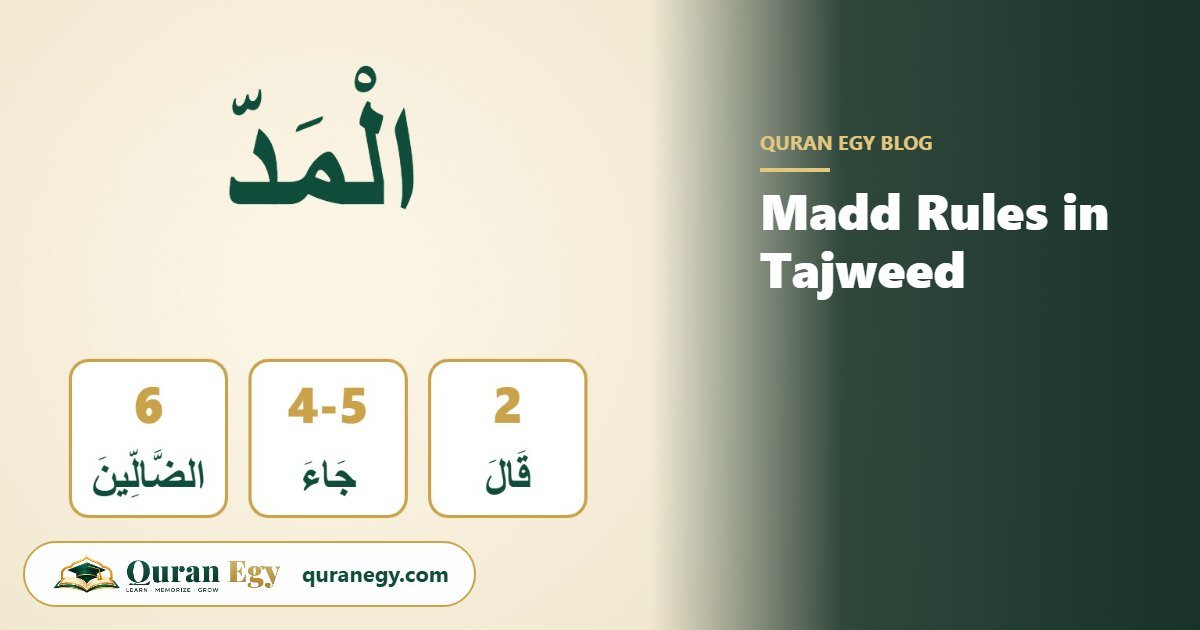
| Natural (tabee'i) | A madd letter with no hamzah or sukoon after it | 2 counts |
| Obligatory joined (wajib muttasil) | Madd letter and hamzah in the same word, as in جَاءَ | 4 or 5 counts |
| Permissible separated (ja'iz munfasil) | Madd letter at the end of a word, hamzah at the start of the next, as in إِنَّا أَعْطَيْنَاكَ | 4 or 5 counts |
| Necessary (lazim) | Madd letter followed by a permanent sukoon or shaddah, as in الضَّالِّينَ | 6 counts |
| Temporary sukoon ('arid lis-sukun) | Stopping on a word after a madd letter, as in الرَّحِيمْ | 2, 4 or 6 counts |
| Leen | Waw or ya with sukoon after a fatha, when stopping, as in خَوْفْ | 2, 4 or 6 counts |
The key advanced skill is consistency: if you choose 4 counts for the separated madd, keep 4 counts every time in that recitation.
2. Idgham between letters
Beyond noon and meem, idgham also happens when two letters meet:
| Type | Meaning | Example |
|---|---|---|
| Mutamathilayn | Two identical letters | اضْرِب بِّعَصَاكَ |
| Mutajanisayn | Same makhraj, different qualities | قَد تَّبَيَّنَ |
| Mutaqaribayn | Close makharij | قُل رَّبِّ |
Each type has its own conditions for when the merge is full or partial. You can see the examples in context on quran.com.
3. Heavy and light ra and lam
Ra is heavy (tafkheem) when it has a fatha or damma, as in رَبِّ, and light (tarqeeq) when it has a kasra, as in رِجَال. With sukoon, it depends on the letter before it and sometimes after it, which is where most of the detail lies.
Lam is light everywhere except in the name of Allah, where it is heavy after a fatha or damma (as in قَالَ اللَّهُ) and light after a kasra (as in بِسْمِ اللَّهِ).
4. Levels of tafkheem and qalqalah
The heavy letters (خ ص ض غ ط ق ظ) are not all equally heavy. Scholars describe levels, from heaviest with a fatha followed by alif, to lightest with a kasra. Qalqalah (the echo on ق ط ب ج د) is also stronger when you stop on the letter, especially with shaddah, as in الْحَقّ, than in the middle of a word.
5. Waqf and ibtida (stopping and starting)
Knowing where to stop is as important as how. The Mushaf uses signs above the text:
| Sign | Meaning |
|---|---|
| مـ | Necessary stop: continuing may change the meaning |
| لا | Do not stop here |
| ج | Stopping and continuing are both fine |
| صلى | Continuing is better |
| قلى | Stopping is better |
| ∴ ∴ | Stop at one of the two places, not both |
When you stop in the middle of a long ayah to breathe, restart from a point that keeps the meaning clear, not in the middle of a phrase.
6. Special words in the recitation of Hafs
A few named places have their own rules:
| Rule | Where | What happens |
|---|---|---|
| Sakt (short pause without breath) | Al-Kahf 18:1, Ya-Sin 36:52, Al-Qiyamah 75:27, Al-Mutaffifin 83:14 | A brief silent pause |
| Imalah | مَجْرَاهَا in Hud 11:41 | The alif leans toward an "e" sound |
| Ishmam | تَأْمَنَّا in Yusuf 12:11 | The lips round briefly |
| Tasheel | أَأَعْجَمِيٌّ in Fussilat 41:44 | The second hamzah is softened |
These are learned by hearing them from a teacher. Reading about them is not enough.
How to practise advanced rules
- Recite full pages to a teacher, not single lines.
- Record yourself once a week and compare with a clear reciter.
- Focus on one area per month, such as madd lengths or waqf.
- Mark your Mushaf with the places you keep getting wrong.
Advanced Tajweed at Quran Egy
Levels 3 and 4 of our online Tajweed course cover madd, qalqalah, tafkheem and tarqeeq, ra and lam, and waqf and ibtida, mostly by reciting full pages while the teacher corrects in real time. Students who want to go further move into the Ijazah program or study the other recitations in the Ten Qira'at course. If you want a formal record of your level, read about our Tajweed certificate levels. See plans on the pricing page.
One-to-one · Azhari-trained · first class free
Frequently asked questions
What are advanced Tajweed rules?
They include exact madd lengths, idgham between letters, heavy and light ra and lam, levels of tafkheem and qalqalah, waqf and ibtida, and the special words of Hafs.
How long does it take to learn advanced Tajweed?
With 3 classes a week, most students need about 4 months after the basics, plus regular practice.
What is sakt in Tajweed?
Sakt is a brief pause without taking a breath. In Hafs it is required in four places, including Al-Kahf 18:1 and Ya-Sin 36:52.
How many counts is the necessary madd?
The necessary madd (madd lazim) is always 6 counts.
Can I learn advanced Tajweed from books?
Books explain the rules, but advanced Tajweed is learned by reciting to a teacher who hears and corrects you.
Do I need advanced Tajweed for an Ijazah?
Yes. An Ijazah requires a full, precise application of all Tajweed rules in your recitation.