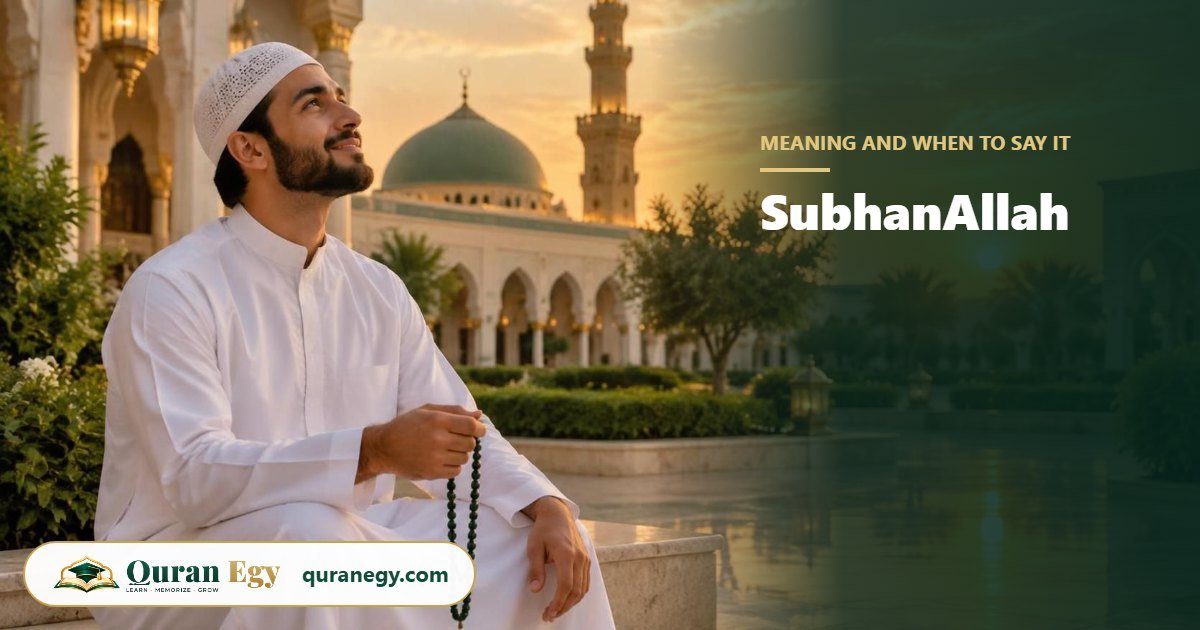
You hear it after a beautiful sunset, a narrow escape on the road, or a child's surprising question. SubhanAllah is one of the first Arabic phrases a Muslim learns, and one of the most repeated: at least 33 times after every prayer, and in every bowing and prostration.
Yet many people say it without knowing what it actually declares. This guide explains the meaning of SubhanAllah word by word, where it comes from in the Quran, when the Prophet ﷺ said it, and why he described it as light on the tongue but heavy on the scale.
Key takeaways
- SubhanAllah (سبحان الله) means "Glory be to Allah": Allah is far above every flaw, weakness and need.
- It is called tasbih, and the whole universe does it: "There is nothing except that it glorifies His praise" (Al-Isra 17:44).
- The Sunnah after each obligatory prayer is 33 SubhanAllah, 33 Alhamdulillah and 33 Allahu Akbar, completed to 100 (Sahih Muslim).
- "SubhanAllahi wa bihamdihi" said 100 times a day wipes away sins, even if they are like the foam of the sea (Bukhari and Muslim).
- Muslims also say it when amazed or surprised, as the Prophet ﷺ did.
What does SubhanAllah mean?
SubhanAllah (سُبْحَانَ اللَّهِ) means "Glory be to Allah" or "How perfect Allah is". When you say it, you declare that Allah is free from every imperfection: He does not tire, forget, sleep, need help, or have a partner or a child.
The phrase has two words:
| Word | Arabic | Meaning |
|---|---|---|
| Subhana | سُبْحَانَ | glory, exaltation, being far above any flaw |
| Allah | اللَّهِ | Allah, the one true God |
Subhan comes from the root s-b-ḥ (س ب ح), which carries the idea of moving swiftly and far, like a swimmer (سابح) gliding through water. The image is of Allah being far, far removed from anything that does not befit Him. The act of saying it is called tasbih (تسبيح), and the beads many people use to count it are called misbaha or subha.
A simple way to explain it to a child: Alhamdulillah says "Allah is good to me". SubhanAllah says "Allah has no faults at all".
SubhanAllah in the Quran
The root of tasbih appears close to 90 times in the Quran. A few places stand out.
The Quran tells us that all of creation is already saying it:
"The seven heavens and the earth and whatever is in them exalt Him. And there is not a thing except that it exalts [Allah] by His praise, but you do not understand their way of exalting." (Al-Isra 17:44)
Surah Al-Isra itself opens with the word: "Subhana alladhi asra bi'abdihi laylan...", "Exalted is He who took His servant by night" (17:1). The miracle of the Night Journey begins with tasbih, because it is a reminder that nothing is beyond Allah's power.
Seven surahs open with a form of the same word, including Al-Hadid, Al-Hashr, As-Saff, Al-Jumu'ah, At-Taghabun and Al-A'la. Al-A'la begins with a command: "Sabbih isma rabbika al-a'la", "Exalt the name of your Lord, the Most High" (87:1).
And when the Prophet ﷺ was given victory, he was not told to celebrate. He was told: "Then exalt [Him] with praise of your Lord and ask forgiveness of Him" (An-Nasr 110:3).
The reward of saying SubhanAllah
Several authentic hadith describe how much this short phrase is worth.
Heavy on the scale. The Prophet ﷺ said: "Two words are light on the tongue, heavy on the scale, and beloved to the Most Merciful: SubhanAllahi wa bihamdihi, SubhanAllahil-'Azim." (Sahih al-Bukhari 6406, also in Sahih Muslim). This is the hadith with which Imam al-Bukhari chose to end his entire collection.
Sins wiped away. "Whoever says SubhanAllahi wa bihamdihi a hundred times in a day, his sins are removed, even if they are like the foam of the sea." (Bukhari and Muslim)
A tree in Paradise. "Whoever says SubhanAllahil-'Azimi wa bihamdihi, a palm tree is planted for him in Paradise." (Tirmidhi, graded sahih)
Among the most beloved words. The Prophet ﷺ said the four words most beloved to Allah are SubhanAllah, Alhamdulillah, La ilaha illallah and Allahu Akbar, and it does not matter which you start with. (Sahih Muslim)
When to say SubhanAllah
| Moment | What to say | Source |
|---|---|---|
| After each obligatory prayer | SubhanAllah 33, Alhamdulillah 33, Allahu Akbar 33, then La ilaha illallahu wahdahu la sharika lah... | Sahih Muslim |
| In ruku' (bowing) | Subhana rabbiyal-'Azim | Sahih Muslim |
| In sujud (prostration) | Subhana rabbiyal-A'la | Sahih Muslim |
| Before sleeping | SubhanAllah 33, Alhamdulillah 33, Allahu Akbar 34 | Bukhari and Muslim |
| Walking downhill or going down stairs | SubhanAllah | Sahih al-Bukhari |
| Morning and evening | SubhanAllahi wa bihamdihi 100 times | Sahih Muslim |
| When amazed or surprised | SubhanAllah | Sahih al-Bukhari |
After prayer: the 33-33-33
The Prophet ﷺ said that whoever says SubhanAllah 33 times, Alhamdulillah 33 times and Allahu Akbar 33 times after every prayer, then completes a hundred with La ilaha illallahu wahdahu la sharika lah, lahul-mulku wa lahul-hamd, wa huwa 'ala kulli shay'in qadir, his sins are forgiven even if they are like the foam of the sea (Sahih Muslim).
Before sleep: the gift to Fatimah
When Fatimah, may Allah be pleased with her, asked her father ﷺ for a servant to help with the hard housework, he taught her and Ali something he said was better than a servant: 33 SubhanAllah, 33 Alhamdulillah and 34 Allahu Akbar when going to bed (Bukhari and Muslim). Many families still teach it to children as their bedtime dhikr.
Going up and coming down
Jabir ibn Abdullah said: "When we went up, we said Allahu Akbar, and when we went down, we said SubhanAllah." (Sahih al-Bukhari). Going up, you declare Allah greater than any height. Going down, you declare Him free from any lowness.
When surprised
SubhanAllah is also the Muslim reaction to something surprising, whether good or not. Abu Hurairah once slipped away from the Prophet ﷺ because he was in a state of major impurity and felt shy to sit with him. When he explained, the Prophet ﷺ said: "SubhanAllah! A believer does not become impure." (Sahih al-Bukhari). The phrase there expresses amazement, not praise of a beautiful sight.
SubhanAllah vs Alhamdulillah vs Masha Allah
These three are often mixed up, especially by new Muslims. The difference is simple:
| Phrase | Meaning | Use it when |
|---|---|---|
| SubhanAllah | Glory be to Allah | you are amazed, or you want to declare Allah free of flaws |
| Alhamdulillah | All praise is for Allah | you are thankful, or someone asks how you are |
| Masha Allah | What Allah has willed | you see a blessing and want to protect it from envy |
So when a friend shows you their newborn, Masha Allah fits best. When you see a stunning mountain view, SubhanAllah fits best. When you get good news, Alhamdulillah. You can read more in our guides to Alhamdulillah and Masha Allah.
How to write SubhanAllah
In Arabic it is two words: سبحان الله, with full vowels سُبْحَانَ اللَّهِ.
In English you will see SubhanAllah, Subhan Allah and Subhanallah. All are fine. Subhan Allah shows the two words most clearly. Avoid shortening it to "SWT" in speech; that abbreviation stands for subhanahu wa ta'ala ("glorified and exalted is He"), which is a related but different phrase written after the name of Allah.
Pronunciation tip: the ḥ in subḥan is a breathy sound from the middle of the throat, not the English "h". Think of the sound you make when you breathe on glasses to clean them. Getting that letter right is part of the first level of our online Tajweed course.
Making tasbih a daily habit
A few practical ideas that work for busy adults and for children:
- Attach it to something you already do. Waiting for the kettle, stopping at a red light, walking to the car: each is a good time for ten SubhanAllah.
- Count on your fingers. The Prophet ﷺ counted tasbih on the fingers of his right hand, and said the fingers will be asked and will speak on the Day of Judgment (Abu Dawud and Tirmidhi).
- Learn the meaning with the words. Saying it while thinking "Allah has no flaw" changes how it feels.
- For children, make it a game. After Maghrib, see who can finish the 33-33-33 calmly and correctly, not fastest.
If you want your family to learn the daily adhkar properly, with their meanings and the right pronunciation, our Duas and Adhkar course teaches them in short one-to-one classes. Children can join through our Quran classes for kids, where adhkar are part of every lesson plan.
Azhari-trained teachers · male & female · kids and adults
Frequently asked questions
What does SubhanAllah mean in English?
It means "Glory be to Allah": Allah is perfect and far above every flaw, weakness and need.
How many times should I say SubhanAllah after prayer?
33 times, with 33 Alhamdulillah and 33 Allahu Akbar, then complete 100 with La ilaha illallahu wahdahu la sharika lah (Sahih Muslim).
What is the reward of SubhanAllahi wa bihamdihi?
Saying it 100 times a day removes sins even if they are like the foam of the sea (Bukhari and Muslim).
Can I say SubhanAllah when I see something beautiful?
Yes. It expresses amazement at Allah's creation. When the beauty is a blessing someone has, Masha Allah is also said to protect it from envy.
What is the difference between SubhanAllah and Subhanahu wa ta'ala?
SubhanAllah is a statement of dhikr. Subhanahu wa ta'ala means "glorified and exalted is He" and is said or written after the name of Allah.
Can I count tasbih on beads?
Many scholars allow it. Counting on the fingers of the right hand is the Sunnah, and is what the Prophet ﷺ did.