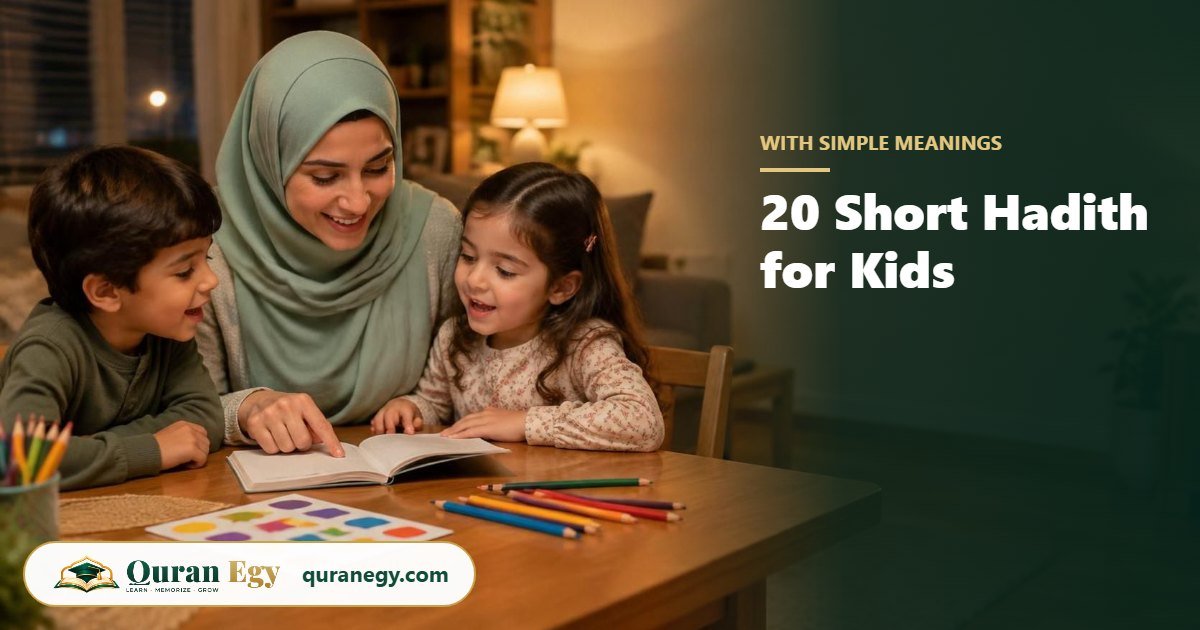
The best hadith for children are short, authentic and easy to act on, such as "Actions are by intentions", "Do not get angry" and "Your smile for your brother is charity". Below are 20 short hadith a child can memorize, one a week, each with the Arabic text, a simple meaning, the source, and a small idea to practise it at home. Most are from Sahih Al-Bukhari and Sahih Muslim, and you can check every one on sunnah.com.
Hadith teach children how the Prophet ﷺ lived: how he spoke, ate, treated people and worshipped. Memorizing a few short ones gives a child words to live by for life.
Key takeaways
- One hadith a week is a good pace for most children.
- Learn the Arabic and the meaning together, so the child knows what they are saying.
- Act on it the same week, so the hadith becomes a habit, not just words.
- Use authentic sources and say the source when you teach it.
- Start from about age 5, once a child can repeat a short sentence.
How to teach a hadith to a child
- Tell a short story or situation where the hadith fits.
- Say the Arabic slowly, and let the child repeat it three times.
- Explain the meaning in one sentence.
- Pick one action for the week, such as smiling at a sibling every morning.
- Revise the earlier hadith once a week, just like Quran revision.
The 20 hadith
| # | Hadith (Arabic) | Simple meaning | Source |
|---|---|---|---|
| 1 | إِنَّمَا الْأَعْمَالُ بِالنِّيَّاتِ | Deeds count by what you intend in your heart | Bukhari 1 |
| 2 | خَيْرُكُمْ مَنْ تَعَلَّمَ الْقُرْآنَ وَعَلَّمَهُ | The best of you learn the Quran and teach it | Bukhari 5027 |
| 3 | لَا تَغْضَبْ | Do not get angry | Bukhari 6116 |
| 4 | تَبَسُّمُكَ فِي وَجْهِ أَخِيكَ لَكَ صَدَقَةٌ | Smiling at your brother is charity | Tirmidhi 1956 |
| 5 | الْكَلِمَةُ الطَّيِّبَةُ صَدَقَةٌ | A kind word is charity | Bukhari 2989 |
| 6 | الطُّهُورُ شَطْرُ الْإِيمَانِ | Being clean is half of faith | Muslim 223 |
| 7 | الْحَيَاءُ مِنَ الْإِيمَانِ | Modesty is part of faith | Bukhari 24 |
| 8 | الدِّينُ النَّصِيحَةُ | The religion is sincerity and good advice | Muslim 55 |
| 9 | مَنْ لَا يَرْحَمُ لَا يُرْحَمُ | Whoever does not show mercy is not shown mercy | Bukhari 5997 |
| 10 | يَسِّرُوا وَلَا تُعَسِّرُوا، وَبَشِّرُوا وَلَا تُنَفِّرُوا | Make things easy, not hard; give good news, do not push people away | Bukhari 69 |
| 11 | إِنَّ اللَّهَ جَمِيلٌ يُحِبُّ الْجَمَالَ | Allah is beautiful and loves beauty | Muslim 91 |
| 12 | لَا يَشْكُرُ اللَّهَ مَنْ لَا يَشْكُرُ النَّاسَ | Whoever does not thank people does not thank Allah | Abu Dawud 4811 |
| 13 | دَعْ مَا يَرِيبُكَ إِلَى مَا لَا يَرِيبُكَ | Leave what makes you unsure for what you are sure of | Tirmidhi 2518 |
| 14 | مِنْ حُسْنِ إِسْلَامِ الْمَرْءِ تَرْكُهُ مَا لَا يَعْنِيهِ | A good Muslim leaves what does not concern him | Tirmidhi 2317 |
| 15 | الْمُسْلِمُ مَنْ سَلِمَ الْمُسْلِمُونَ مِنْ لِسَانِهِ وَيَدِهِ | A Muslim does not hurt others with his words or his hands | Bukhari 10 |
| 16 | أَحَبُّ الْأَعْمَالِ إِلَى اللَّهِ أَدْوَمُهَا وَإِنْ قَلَّ | Allah loves the deeds done regularly, even if small | Bukhari 6464 |
| 17 | لَا يُؤْمِنُ أَحَدُكُمْ حَتَّى يُحِبَّ لِأَخِيهِ مَا يُحِبُّ لِنَفْسِهِ | You do not truly believe until you want for your brother what you want for yourself | Bukhari 13 |
| 18 | مَنْ كَانَ يُؤْمِنُ بِاللَّهِ وَالْيَوْمِ الْآخِرِ فَلْيَقُلْ خَيْرًا أَوْ لِيَصْمُتْ | Say something good or stay quiet | Bukhari 6018 |
| 19 | لَيْسَ الشَّدِيدُ بِالصُّرَعَةِ، إِنَّمَا الشَّدِيدُ الَّذِي يَمْلِكُ نَفْسَهُ عِنْدَ الْغَضَبِ | The strong person is the one who controls himself when angry | Bukhari 6114 |
| 20 | يَا غُلَامُ، سَمِّ اللَّهَ، وَكُلْ بِيَمِينِكَ، وَكُلْ مِمَّا يَلِيكَ | Young boy, say Bismillah, eat with your right hand, and eat from what is in front of you | Bukhari 5376 |
The list goes roughly from shortest to longest, so younger children can start at the top and older children can take the longer ones.
Practice ideas for each week
| Hadith | One action for the week |
|---|---|
| Actions are by intentions | Before school, say what you intend: "I go to learn and please Allah" |
| Do not get angry | When upset, sit down, stay quiet, make wudu |
| Smiling is charity | Smile at each family member at breakfast |
| A kind word is charity | Say one kind thing to a sibling every day |
| Cleanliness is half of faith | Make your bed and wash hands before eating |
| Thank people | Say "JazakAllahu khayran" to whoever helps you |
| Say good or stay quiet | Catch yourself before saying something unkind |
| Say Bismillah and eat with your right hand | Practise at every meal |
Ages and pace
| Age | Suggested pace | Focus |
|---|---|---|
| 5 to 6 | 1 short hadith every 2 weeks | Hadith 1 to 8, Arabic by repetition |
| 7 to 9 | 1 hadith a week | Hadith 1 to 15, meaning and action |
| 10 and up | 1 to 2 a week | All 20, plus the story behind each |
Hadith and the Quran together
Many families pair a weekly hadith with Quran memorization: one short surah and one hadith. The first hadith on this list, about intention, is a good one to start any Quran lesson with. For Quran memorization ideas, see our best surahs to memorize and the free Juz Amma memorization tracker. Daily duas are another short, practical set; our duas and adhkar course teaches them step by step.
Learn hadith with a teacher
Hadith is part of our Islamic studies course, where children learn short hadith with stories, simple explanations and small quizzes, adapted to their age. Many families add it to their child's Quran classes for kids, so one teacher covers both. Islamic studies can be booked by the hour at $10, or added to a monthly plan; see the pricing page.
Short, fun one-to-one classes · male & female teachers · first class free
Frequently asked questions
What is a good first hadith for kids?
"Actions are by intentions" (Bukhari 1) is a common first hadith. It is short and teaches children to think about why they do things.
How many hadith should a child memorize?
Start with one a week. Twenty short hadith in five to six months is a realistic goal for children aged 7 to 9.
At what age can children memorize hadith?
From about age 5, children can repeat and memorize very short hadith, especially with a story.
Are these hadith authentic?
Yes. They come from Sahih Al-Bukhari, Sahih Muslim, Sunan At-Tirmidhi and Sunan Abu Dawud. You can check each one on sunnah.com.
Should kids learn hadith in Arabic or English?
Both. Memorize the Arabic words and learn the meaning in English, so the child understands what they say.
How do I make hadith memorization fun?
Tell a short story, use a sticker chart, and choose one action each week that puts the hadith into practice.