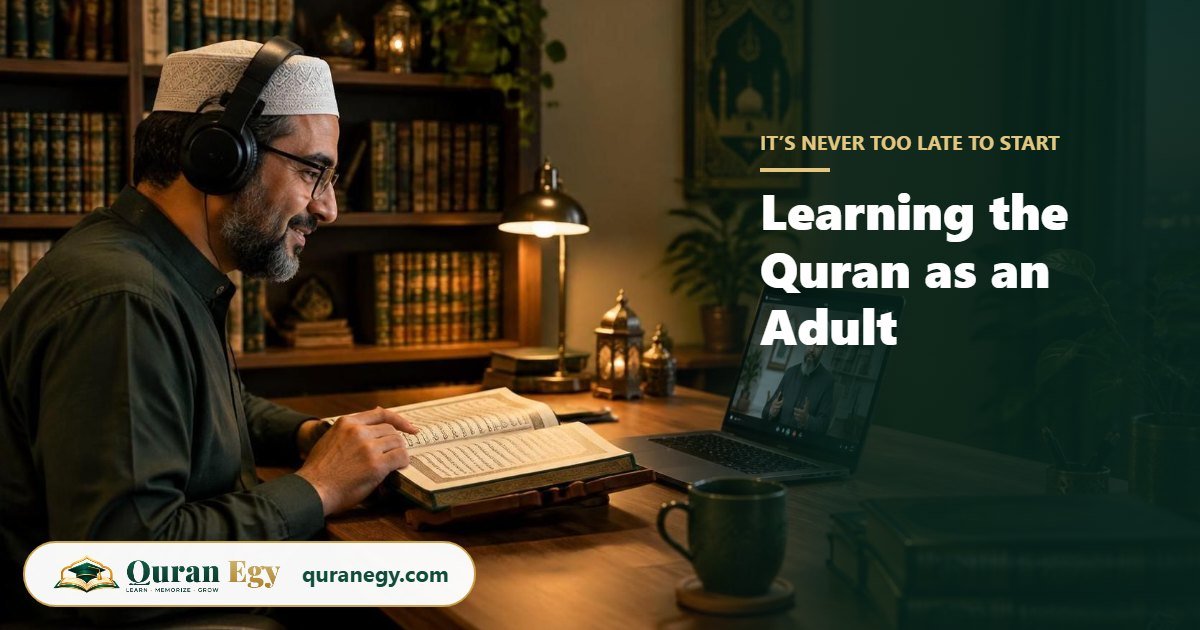
It is not too late. Most adults who start from zero can read simple Quranic pages within three to six months, with three short lessons a week and ten to fifteen minutes of practice a day. Adults usually learn the letters faster than children, because they understand rules and can practise on purpose.
What holds adults back is rarely ability. It is embarrassment, a busy schedule, and not knowing where to start. This guide gives you a clear order of steps, a weekly routine that fits a full-time job, and the mistakes we see most often in adult beginners.
Key takeaways
- Starting point: the Arabic letters and vowels, usually through the Noorani Qaida.
- Typical timeline: 2 to 4 months to read slowly, 6 to 12 months to read fluently with basic Tajweed.
- Best routine: 3 classes a week plus 10 to 15 minutes of daily practice.
- Biggest mistake: relying on transliteration for too long.
- Reward: the Prophet ﷺ said the one who struggles with the Quran gets a double reward (Bukhari and Muslim).
Why adults often learn faster than they expect
Children have time and memory on their side. Adults have other strengths:
- You understand rules. "This mark means stretch for two counts" makes sense straight away.
- You know why you are doing it. Motivation is the biggest predictor of progress.
- You can practise deliberately. Ten focused minutes is worth more than half an hour of distracted reading.
The Prophet ﷺ said: "The one who is skilled in the Quran will be with the noble and righteous scribes, and the one who reads the Quran and stumbles over it, finding it difficult, will have two rewards." (Sahih Muslim 798). Struggling at the start is not something to hide. It is rewarded.
The order to learn things in
| Stage | What you learn | Typical time (3 classes a week) |
|---|---|---|
| 1. Letters | The 28 letters, their sounds and shapes | 3 to 5 weeks |
| 2. Vowels | Fatha, kasra, damma, sukun, tanween, shadda | 3 to 4 weeks |
| 3. Joining | How letters connect inside words | 3 to 4 weeks |
| 4. Long vowels and stops | Madd letters, where to pause | 2 to 3 weeks |
| 5. First pages | Reading short surahs from the mushaf | ongoing |
| 6. Basic Tajweed | Noon and meem rules, madd, qalqalah | 2 to 4 months |
Stages 1 to 4 are what the Noorani Qaida covers. Stage 6 is where our Tajweed rules for beginners guide comes in. Every adult moves at a different speed, so your teacher will adjust this to you.
A weekly routine for busy adults
| Day | Class | Home practice (10 to 15 min) |
|---|---|---|
| Monday | 30 to 45 min class | Re-read today's page twice |
| Tuesday | — | Read Monday's page once, listen to it once |
| Wednesday | 30 to 45 min class | Re-read today's page twice |
| Thursday | — | Read the week's pages once |
| Friday | — | Listen to Surah Al-Kahf while commuting |
| Saturday | 30 to 45 min class | Re-read today's page twice |
| Sunday | — | Rest, or review anything that felt hard |
Morning practice before work, or straight after Fajr, works best for most people. Evening practice after a long day tends to slip.
Common mistakes adult beginners make
1. Staying on transliteration. Reading "Bismillah" in English letters feels easier at first, but it hides sounds that English does not have. Use it for a week or two at most, then switch to the Arabic.
2. Rushing the letters. Adults are keen to "get to the Quran". Skipping a solid foundation in the letters and vowels usually means going back to it later.
3. Learning only from apps or videos. They are useful for practice, but nobody corrects you. Mistakes in letters like 'ayn, ḥa and qaf become habits within weeks.
4. Inconsistent practice. One long session at the weekend does less than ten minutes every day.
5. Comparing yourself to others. The person next to you at the masjid may have studied since age six. Compare yourself only with where you were last month.
How a teacher speeds things up
You can learn some of this alone, but a teacher shortens the process a lot. In one-to-one classes your teacher hears every sound, fixes it before it becomes a habit, and tells you exactly what to practise. Our Quran reading course is built for this stage, and adults who start from the very beginning take the Noorani Qaida course first.
Adults who also want to understand what they read often add one class a week from our Arabic language course once they can read. And once reading is comfortable, many go on to memorize short surahs in the Quran memorization course.
Prices: from $40 a month for 2 classes a week, up to $85 for 5. Class length (30, 45 or 60 minutes) is set with you, and your first class is free. See pricing.
"I'm embarrassed to start this late"
Many of our adult students say this in their first class. Some grew up in non-practising families. Some are new Muslims. Some learned as children and forgot. One-to-one classes exist for exactly this reason: nobody else is listening, and your teacher has heard every beginner mistake many times before.
Remember the Companions. Many of them learned to read and memorize the Quran as adults, after accepting Islam.
One-to-one · patient teachers · male & female · first class free
Frequently asked questions
Is it too late to learn the Quran as an adult?
No. Adults of any age can learn to read the Quran, and many find it faster than they expected.
How long does it take an adult to learn to read the Quran?
Usually 2 to 4 months to read slowly and 6 to 12 months to read fluently with basic Tajweed, with 3 classes a week and daily practice.
Can I learn the Quran on my own as an adult?
You can start alone with apps and videos, but a teacher is needed to correct pronunciation and Tajweed.
What should an adult learn first?
The Arabic letters and vowels, usually through the Noorani Qaida, before moving on to the mushaf.
How much time do I need each day?
Ten to fifteen minutes of focused practice on most days, plus your classes.
Is there a reward for struggling with the Quran?
Yes. The Prophet ﷺ said the one who reads it with difficulty gets two rewards (Sahih Muslim 798).