If you open a mushaf printed in Morocco next to one printed in Egypt or Saudi Arabia, you may notice that a few dots are in different places and some words look slightly different. Listen to a Moroccan imam lead Taraweeh and you will hear longer stretches and some softer hamzas. Both are reciting the same Quran. One is reading in the narration of Hafs, the other in the narration of Warsh.
This guide explains who Hafs and Warsh were, where each recitation is used today, the main differences with clear examples, and which one makes sense for you to learn.
Key takeaways
- Hafs narrates the reading of 'Asim of Kufa. Warsh narrates the reading of Nafi' of Madinah.
- Both are authentic, mass-transmitted (mutawatir) recitations going back to the Prophet ﷺ. Neither is "more correct".
- Hafs is the most widespread narration in the world today. Warsh is the main narration in Morocco, Algeria, Mauritania and much of West Africa.
- Most differences are in pronunciation rules (madd length, hamza, heavy lam). A smaller number are in specific words.
- Learn Hafs first unless your community recites Warsh. Learn Warsh later through a structured Qira'at course.
Who were Hafs and Warsh?
The Quran was revealed in seven ahruf (modes), as the Prophet ﷺ said in a hadith reported by Bukhari and Muslim. Over the first centuries, scholars recorded the readings that were transmitted in a fully authentic way. Ten readers became the standard, and for each reader two main narrators (rawis) are studied. Hafs and Warsh are two of these twenty narrators.
| Hafs | Warsh | |
|---|---|---|
| Full name | Hafs ibn Sulayman al-Asadi | 'Uthman ibn Sa'id al-Misri |
| Died | 180 AH | 197 AH |
| Narrates from | 'Asim ibn Abi al-Najud | Nafi' ibn 'Abd al-Rahman |
| Teacher's city | Kufa (Iraq) | Madinah |
| Chain | 'Asim from Abu 'Abd al-Rahman al-Sulami, from 'Ali, Ibn Mas'ud, Ubayy and others, from the Prophet ﷺ | Nafi' from about 70 of the Tabi'in of Madinah, from the Companions, from the Prophet ﷺ |
| Nickname | — | "Warsh" was a nickname given by his teacher, reportedly because of his very fair complexion |
Interestingly, Warsh was an Egyptian. He travelled to Madinah to read the whole Quran to Imam Nafi', then returned to Egypt and taught there for decades. His narration spread west across North Africa from Egypt.
Where is each recitation used today?
| Narration | Main regions today |
|---|---|
| Hafs 'an 'Asim | Egypt, the Arabian Peninsula, the Levant, Iraq, Turkey, Iran, South Asia, Southeast Asia, Europe and the Americas |
| Warsh 'an Nafi' | Morocco, Algeria, Mauritania, Senegal, Mali, Niger and parts of West and North Africa |
| Qalun 'an Nafi' | Libya, Tunisia (the other narration of Nafi') |
| Al-Duri 'an Abi 'Amr | Parts of Sudan, Chad and Somalia |
Hafs became the most common narration largely through the Ottoman period and, later, the printed Egyptian and Madinah mushafs. Today most printed copies of the Quran in the world follow Hafs.
The main differences between Hafs and Warsh
Scholars divide the differences into two kinds: usul (general rules that apply throughout the Quran) and farsh (specific words read differently).
1. Length of madd (stretching)
| Type of madd | Hafs (via Ash-Shatibiyyah) | Warsh |
|---|---|---|
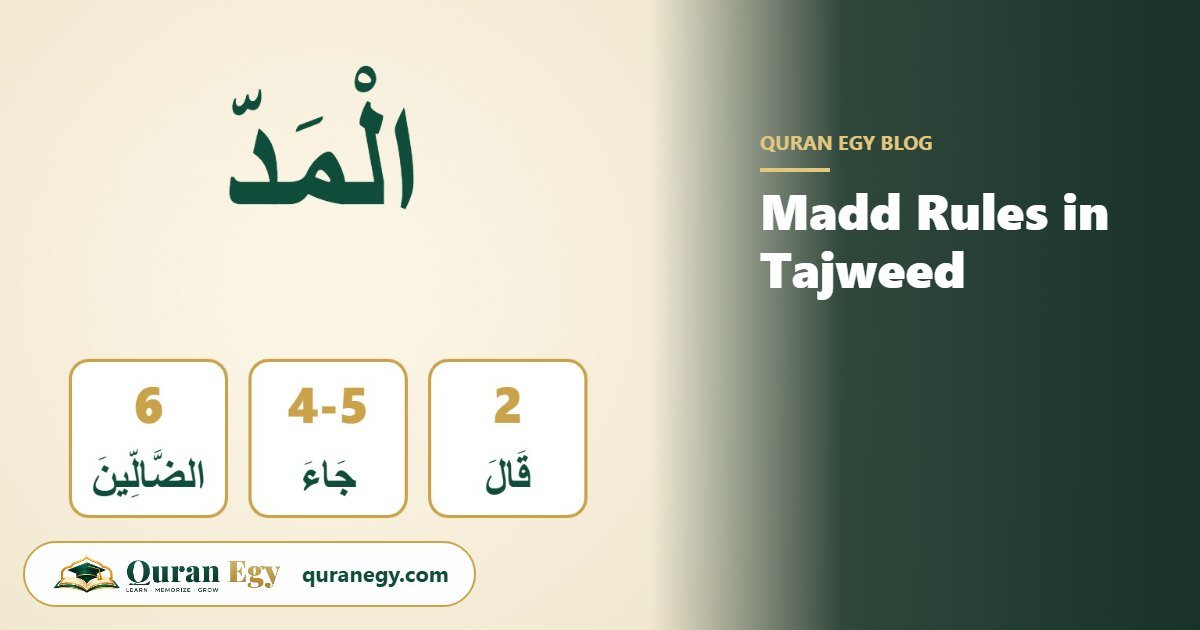
| Madd muttasil (hamza in the same word, e.g. جَاءَ) | 4 or 5 counts | 6 counts |
| Madd munfasil (hamza in the next word, e.g. يَا أَيُّهَا) | 4 or 5 counts | 6 counts |
| Madd badal (hamza before the letter of madd, e.g. آمَنُوا) | 2 counts | 2, 4 or 6 counts |
This is the first thing most listeners notice: Warsh recitation has longer, fuller stretches.
2. The hamza
Warsh often softens or changes the hamza where Hafs pronounces it fully.
| Example | Hafs | Warsh |
|---|---|---|
| يُؤْمِنُونَ (they believe) | yu'minun | yuminun (hamza becomes a long u) |
| قَدْ أَفْلَحَ (has succeeded) | qad aflaha | qadaflaha (the hamza's vowel moves to the dal, called naql) |
| الْأَرْضِ (the earth) | al-ard | alarḍ (the lam of al- takes the hamza's vowel) |
3. Heavy lam (taghliz)
In Warsh, the lam is pronounced heavy when it has a fatha and comes right after a sad, ta or za with fatha or sukun. The best-known example is الصَّلَاةَ: in Hafs the lam is light, in Warsh it is heavy, like the lam in Allah after a fatha.
4. Light ra and taqlil
Warsh pronounces some ra letters light where Hafs makes them heavy, for example when the ra comes after a ya sakinah or a kasra in certain patterns, as in خَبِيرًا. Warsh also uses taqlil (a slight leaning of the alif towards an "e" sound) in many words ending in alif maqsurah, such as مُوسَىٰ and الْهُدَىٰ.
5. Word differences (farsh)
A smaller set of words are read differently. A few examples:
| Verse | Hafs | Warsh |
|---|---|---|
| Al-Fatiha 1:4 | مَالِكِMaliki (Owner) | مَلِكِMaliki without alif (King) |
| Al-Baqarah 2:10 | يَكْذِبُونَyakdhibun (they lie) | يُكَذِّبُونَyukadhdhibun (they deny) |
| Al-Baqarah 2:132 | وَوَصَّىٰwa wassa | وَأَوْصَىٰwa awsa |
These differences do not contradict each other. Malik (Owner) and Malik (King) are both true of Allah, and both readings were taught by the Prophet ﷺ. Each adds a layer of meaning. Our article on the meaning of Surah Al-Fatiha explains the first of these.
6. Verse counting and the mushaf script
Warsh mushafs follow the Madinan system of counting verses, so the total number of verses is 6,214 instead of the Kufan count of 6,236 used in Hafs mushafs. The words are the same; only the places where a verse ends differ. In Al-Fatiha, for example, the Basmalah is not counted as a verse in the Warsh mushaf, and an'amta 'alayhim ends a verse instead.
Warsh mushafs are usually written in the North African (Maghribi) style: the fa has its dot below, and the qaf has one dot above. So a student used to Hafs mushafs needs a little time before reading a Warsh mushaf comfortably.
Is one more correct than the other?
No. Both are mutawatir: each was transmitted by so many people in every generation that error is ruled out. Scholars agree that it is valid to pray with either, and that denying either one is denying part of the Quran.
What scholars do advise is not to mix them randomly in one recitation, and not to recite Warsh in public prayer where people only know Hafs, to avoid confusion for the listeners.
Which one should you learn?
| Your situation | Our advice |
|---|---|
| You are a beginner or still learning tajweed | Learn Hafs. Almost all teaching material and mushafs outside North and West Africa use it. |
| Your family or mosque recites Warsh | Learn Warsh from the start, with a teacher who recites it. |
| You have memorized the Quran in Hafs with good tajweed | Warsh is an excellent next step and a natural start to the Qira'at. |
| You want an Ijazah | First complete an Ijazah in Hafs, then add Warsh. |
If you are still at the beginning, our Tajweed rules for beginners guide and online Tajweed course are the right place to start.
Learning Warsh and the other Qira'at online
Warsh cannot be learned well from a chart. The madd lengths, the softened hamzas and the heavy lams need to be heard and corrected by someone who learned them with a chain. In our Ten Qira'at course, students who already recite Hafs well learn Warsh and Qalun first, reader by reader, with the rules of Ash-Shatibiyyah explained as they go.
Students who are not yet at that level usually join our Ijazah program in Hafs first. When you finish a narration with your Sheikh, you can receive an Ijazah with sanad for it. Ijazah in Quran is taught only by teachers who hold an Ijazah with sanad themselves, and sisters recite to female Ijazah holders.
The first step is an assessment class where you recite to the Sheikh and he tells you honestly whether you are ready for the Qira'at course or need more work on Hafs.
Sheikhs with Ijazah and sanad · male & female teachers
Frequently asked questions
What is the difference between Hafs and Warsh?
Hafs narrates the reading of 'Asim of Kufa and Warsh narrates the reading of Nafi' of Madinah. They differ mainly in madd length, the hamza, heavy lam and some specific words, but both are authentic recitations of the same Quran.
Is Warsh Quran different from Hafs Quran?
It is the same Quran. The differences are in pronunciation and a small number of words, and all of them were taught by the Prophet ﷺ.
Which countries read Warsh?
Mainly Morocco, Algeria, Mauritania and much of West Africa, such as Senegal, Mali and Niger.
Can I pray with Warsh if I learned Hafs?
Yes, both are valid in prayer. Do not mix the two randomly, and recite in public what the congregation knows.
Is it hard to learn Warsh after Hafs?
Not for a student who recites Hafs well. Most of the work is in the general rules, which become automatic after a few months with a teacher.
How many verses are in the Warsh mushaf?
6,214 verses, following the Madinan count, compared with 6,236 in the Kufan count used in Hafs mushafs.