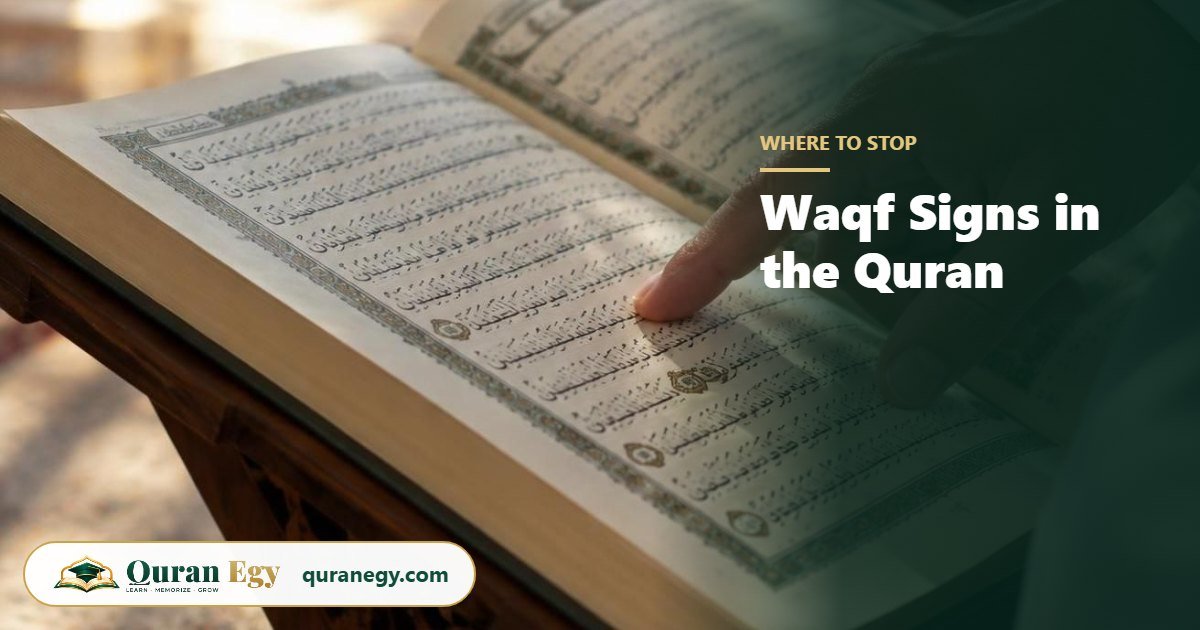
The small symbols printed above the line in the Mushaf are waqf signs: they tell you where you must stop, where you must not stop, and where you may choose. They exist to protect the meaning. Stopping in the wrong place can change what an ayah says, while stopping in the right place makes the meaning clear for you and anyone listening. The signs below are those used in the common Madinah (Hafs) Mushaf.
Key takeaways
- مـ (meem): stopping is necessary here.
- لا (laa): do not stop here.
- ج (jeem): stopping and continuing are equally fine.
- صلى: continuing is better. قلى: stopping is better.
- Three dots ∴ ∴: stop at one of the two places, not both.
The six main signs
| Sign | Name | Meaning | What to do |
|---|---|---|---|
| مـ | Lazim (necessary) | Continuing could give a wrong meaning | Stop |
| لا | Mamnu' (not allowed) | Stopping cuts the meaning | Continue |
| ج | Ja'iz (permissible) | Both are correct | Your choice |
| صلى | Wasl awla | Joining is better | Prefer to continue |
| قلى | Waqf awla | Stopping is better | Prefer to stop |
| ∴ ∴ | Mu'anaqah (embracing) | Two possible stops close together | Stop at one only |
An example of the meem sign
In Surah Al-An'am (6:36), Allah says that only those who hear will respond, and then "as for the dead, Allah will raise them". There is a meem after the first part. If you join the two, it can sound as if the dead also respond, so the stop is necessary.
An example of the three dots
At the start of Surah Al-Baqarah (2:2), "That is the Book, no doubt" has dots after "no doubt" and after "in it". You may stop after "no doubt" or after "in it", but not at both, because each choice gives a complete, correct meaning on its own.
Saktah: a short pause without breath
In the Hafs reading there are places marked with a small س where the reciter makes a saktah: a very short pause without taking a breath, then continues. The four well-known places in Hafs are in Al-Kahf (18:1), Ya-Sin (36:52), Al-Qiyamah (75:27) and Al-Mutaffifin (83:14). Your teacher will show you how long the pause is.
How to stop correctly on a word
When you stop, the last letter changes:
- Most words: the last vowel becomes a sukun. الرَّحِيمِ is read الرَّحِيمْ.
- Tanween with fathah: becomes a long "aa". عَلِيمًا is read عَلِيمَا.
- Ta marbutah (ة): becomes a "h" sound. رَحْمَةً is read رَحْمَهْ.
- Madd before the stop: the madd 'arid lil-sukun may be 2, 4 or 6 counts. See our guide to madd rules.
How to start again after stopping
If you stopped because you ran out of breath in the middle of a meaning, go back a word or two and start from a place that makes sense. Never start from a word that, on its own, gives a meaning the ayah does not intend. Your teacher will show you the common examples.
Signs in other Mushafs
Mushafs printed in South Asia use a longer list of letters (for example ط, ز and ق). The idea is the same: each letter shows how strong the stop is. If you learned from one of those Mushafs, ask your teacher to compare the two systems with you.
Practising waqf with a teacher
Waqf is learned best by listening and reciting. A teacher corrects where you stop, where you start and how you change the last letter. It is a core part of the online Tajweed course and of Tajweed classes for adults. Beginners should first master the basics in Tajweed rules for beginners.
Azhari-trained teachers · male & female · free trial
Frequently asked questions
What does the meem sign mean in the Quran?
It means stopping is necessary, because continuing could give a wrong meaning.
What does laa mean above an ayah?
It means do not stop there, because stopping would cut the meaning.
What is the difference between salaa and qalaa?
With salaa, continuing is better. With qalaa, stopping is better. Both choices are allowed.
What do the three dots mean?
They mark two possible stopping places close together. Stop at one of them, not both.
Is it a sin to stop in the wrong place?
Stopping by mistake or to breathe is not a sin, but you should go back and start again from a place that keeps the meaning correct.