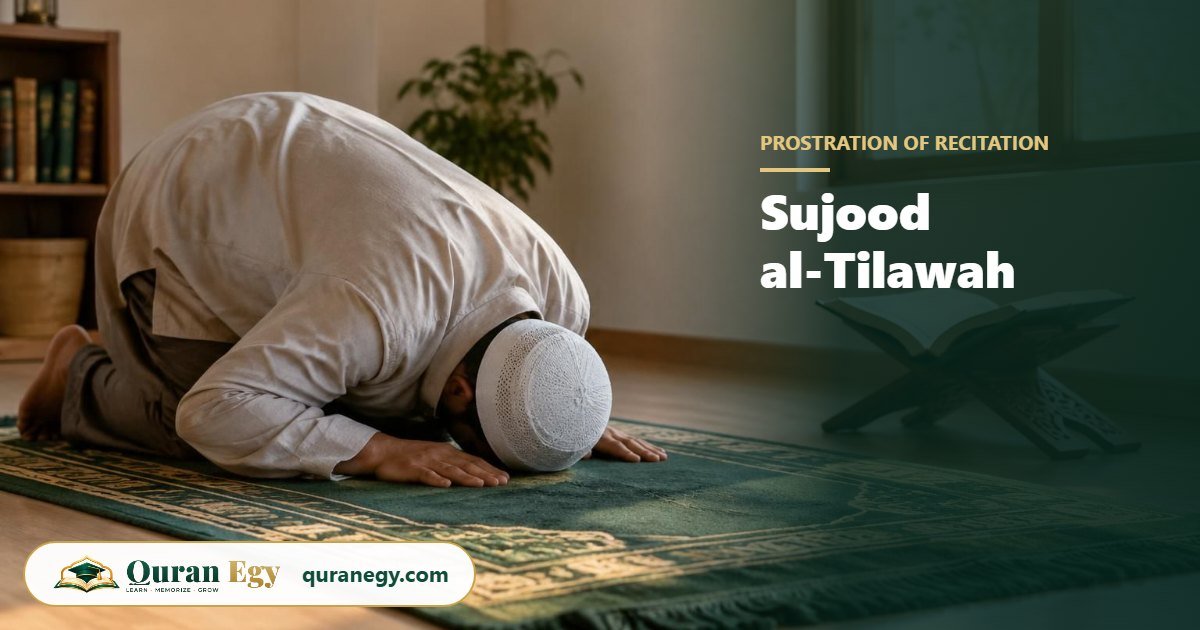
Sujood al-tilawah is the prostration of recitation. When you read or hear certain verses of the Quran, the Sunnah is to make one prostration, then continue reading. There are 15 places marked in the Madinah Mushaf with the sign ۩. The Prophet ﷺ said that when the son of Adam recites a verse of prostration and prostrates, Shaytan withdraws weeping and says he was commanded to prostrate and refused (Sahih Muslim 81).
Key takeaways
- What it is: one prostration when you recite or listen to a verse of sajdah.
- Where: 15 places in the Madinah Mushaf, marked with ۩.
- How: say Allahu Akbar, prostrate once, say your dhikr, then rise.
- What to say: سُبْحَانَ رَبِّيَ الأَعْلَى, and the dua reported from the Prophet ﷺ below.
- Ruling: a confirmed Sunnah according to most scholars; the Hanafi school holds it is wajib.
The 15 places of sajdah in the Quran
| # | Surah | Verse |
|---|---|---|
| 1 | Al-A'raf | 206 |
| 2 | Ar-Ra'd | 15 |
| 3 | An-Nahl | 50 |
| 4 | Al-Isra | 109 |
| 5 | Maryam | 58 |
| 6 | Al-Hajj | 18 |
| 7 | Al-Hajj | 77 |
| 8 | Al-Furqan | 60 |
| 9 | An-Naml | 26 |
| 10 | As-Sajdah | 15 |
| 11 | Sad | 24 |
| 12 | Fussilat | 38 |
| 13 | An-Najm | 62 |
| 14 | Al-Inshiqaq | 21 |
| 15 | Al-Alaq | 19 |
The schools differ slightly on one or two of these. For example, Ibn Abbas said the prostration in Surah Sad is not one of the emphasized ones, but he saw the Prophet ﷺ prostrate there (Sahih al-Bukhari 1069). Following the marks in your Mushaf is enough for everyday reading.
How to perform sujood al-tilawah
- Finish the verse of sajdah.
- Say Allahu Akbar and go down into prostration. Many scholars say you can do this directly from where you are sitting or standing.
- Make one prostration and say your dhikr.
- Rise (many scholars say with Allahu Akbar) and continue reading.
Outside prayer, there is no tashahhud and no tasleem according to many scholars. Inside prayer, if you recite a verse of sajdah, you say Allahu Akbar, prostrate once, then stand up with Allahu Akbar and continue your recitation. The Prophet ﷺ recited As-Sajdah in the Fajr prayer on Fridays and prostrated in it.
What to say in the prostration of recitation
You can say what you say in any sujood:
سُبْحَانَ رَبِّيَ الأَعْلَى
Subhana rabbiyal a'la (Glory be to my Lord, the Most High).
Aisha (may Allah be pleased with her) reported that the Prophet ﷺ used to say in the prostration of recitation:
سَجَدَ وَجْهِيَ لِلَّذِي خَلَقَهُ وَشَقَّ سَمْعَهُ وَبَصَرَهُ بِحَوْلِهِ وَقُوَّتِهِ
Sajada wajhiya lilladhi khalaqahu wa shaqqa sam'ahu wa basarahu bi hawlihi wa quwwatih (My face has prostrated to the One who created it and brought forth its hearing and sight by His might and power). (Sunan Abi Dawud 1414, Jami at-Tirmidhi 580)
If you do not know these by heart, any dhikr and dua in your prostration is fine.
Is sujood al-tilawah obligatory?
Most scholars (the Maliki, Shafi'i and Hanbali schools) say it is a confirmed Sunnah, not an obligation. Their evidence includes the statement of Umar ibn al-Khattab on the minbar that Allah did not make it obligatory, except for whoever wishes (Sahih al-Bukhari 1077), and the report that Zaid ibn Thabit recited An-Najm to the Prophet ﷺ and he did not prostrate (Sahih al-Bukhari 1073). The Hanafi school holds that it is wajib for the reciter and the listener. Either way, it is a beautiful act you should not leave without a reason.
Do you need wudu for sujood al-tilawah?
Most scholars say the same conditions as prayer apply: wudu, facing the qiblah and covering the awrah. Some scholars did not require wudu, and al-Bukhari mentions that Ibn Umar used to prostrate without wudu. If you are reading from memory without wudu and reach a verse of sajdah, many teachers advise making the prostration if you follow the second view, or simply continuing if you follow the first. The safest habit is to read the Quran with wudu.
Common questions from students
- Listening to a recording: many scholars say the prostration is for the one who recites or listens with attention to a live reciter, so it is not required for a recording, though there is no harm in prostrating.
- Women during menstruation: the majority view needs purity, so she does not prostrate; a minority allows it.
- Repeating the verse: if you repeat the same verse in one sitting (for example while memorizing), one prostration is enough according to many scholars.
- Bad timing: if you are driving or cannot prostrate, you may leave it, since it is not obligatory according to most scholars.
These questions often come up in Quran memorization and recitation classes, where students repeat the verses of sajdah many times.
From our teachers' experience
Students often ask about sujood al-tilawah during class. When we reach a sajdah sign in the Mushaf, the teacher stops, explains what the sign means, teaches the dhikr said in the prostration and shows how to perform it, so students learn it in practice and not only in theory.
One-to-one classes · male & female teachers · free trial
Frequently asked questions
How do you perform sujood al-tilawah?
Say Allahu Akbar, make one prostration, say your dhikr, then rise and continue reading. Outside prayer there is no tashahhud or tasleem according to many scholars.
What do you say in sujood al-tilawah?
Subhana rabbiyal a'la, and the dua: سَجَدَ وَجْهِيَ لِلَّذِي خَلَقَهُ وَشَقَّ سَمْعَهُ وَبَصَرَهُ بِحَوْلِهِ وَقُوَّتِهِ.
How many sajdah are there in the Quran?
The Madinah Mushaf marks 15 places, with two in Surah Al-Hajj.
Is sujood al-tilawah wajib?
Most scholars say it is a confirmed Sunnah. The Hanafi school says it is wajib.
Can I do sujood al-tilawah without wudu?
Most scholars require wudu. Some, including Ibn Umar according to al-Bukhari, prostrated without it.
Do I have to prostrate if I hear a sajdah verse on the radio or a recording?
Many scholars say it is not required for a recording, but prostrating is allowed.